
Bronze Bearing Liners, What’s a metal liner? Parts We’ve Made
Protect critical processing equipment from abrasion by installing wear liners.
Its Purpose: To protect expensive, critical machine parts from damage caused by constant friction, impact, and abrasion.
How It Works: It is installed on the surfaces that take the most abuse. The liner, which is made of a very hard and durable metal, slowly wears away over time. Because it is a separate, consumable part, it can be easily unbolted and replaced.
The Benefit: It is much cheaper and faster to replace a worn-out liner than it is to repair or replace a massive, integrated part of a crusher, shredder, or earth-mover. This saves money and reduces equipment downtime.
Get Instant Quote
To get your instant quote, just send your drawings file and select your production process and material.
Place Order
After placing your order, production will start. You’ll receive regular status updates.
Receive Parts
We provide quality assurance, quality reports, and delivery tracking.
Our complete product range, Plain bushings bronze, maintenance-free, Customized plain bearings to deliver optimal performance
Our slide bearings at a glance.
Introducing a Specific Form: The Bearing Liner / Bushing
While our first discussion was about general “wear plates” that protect flat surfaces (like the inside of a crusher), this text focuses on a liner designed for a different kind of motion: rotation.
-
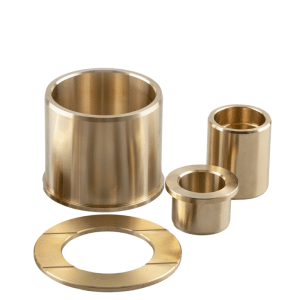
Bearing Liner (or Bushing): This is a liner, typically cylindrical, that fits into a housing to provide a smooth, durable, and replaceable surface for a rotating shaft. Imagine a spinning steel shaft inside a large, heavy iron housing. Instead of having the steel grind directly against the iron, you place a bronze bushing between them.
-
Half Bushing (or Split Bearing): This is a crucial detail. In many machines (like an engine’s crankshaft), you cannot simply slide a full, circular bushing over the end of the shaft. A “half bushing” is a bearing made in two semi-circular halves. This allows you to assemble the bearing around the shaft, making installation and replacement much easier.
Reinforcing the Material Choice: Bronze
This text specifically calls out bronze as a prime material for bearing liners. This reinforces what we discussed earlier:
Low Friction: Bronze has excellent “lubricity,” meaning it’s naturally slippery against steel, reducing wear and heat.
High Durability: As the text states, it resists shock, impact, and wear. It’s soft enough to not damage a steel shaft, but tough enough to last a long time under heavy loads.
Corrosion Resistance: This makes it ideal for marine or other wet environments.
Key Materials for Wear Liners
The text highlights that you can’t just use any metal. The choice of material (the alloy) is engineered for the specific job. Based on the examples given:
-
Bronze, Highly Leaded Bronze, and Copper: These alloys are often chosen for applications with high sliding friction.
-
Natural Lubricity: They are “slippery” compared to steel, reducing friction and heat.
-
Softer than Steel: In a “steel-on-bronze” setup, the bronze liner is designed to wear out first, protecting the much more expensive steel shaft or component.
-
Corrosion Resistance: They hold up well in wet or corrosive environments.
-
-
Nickel Aluminum (likely a type of Aluminum Bronze): This is a high-strength, extremely tough alloy. It’s used for more demanding situations that involve not just friction but also heavy loads, impact, and corrosion. It offers superior strength and wear resistance compared to standard bronze.
The takeaway is: The engineering isn’t just in using a liner, but in selecting the perfect alloy that will wear away at the right rate while effectively protecting the main component from a specific type of damage (e.g., sliding, impact, chemical corrosion).
Expanded Applications and Industries
This new list shows just how universal the concept of a wear liner is. It moves beyond specific machines to entire economic sectors:
-
Heavy Industry (Mining, Construction, Crushers): This is the classic use case we first discussed, protecting equipment from extreme abrasion and impact from rock, dirt, and ore.
-
Energy Sector (Oil & Gas, Power Generation): In these industries, liners protect critical components in pumps, turbines, and drilling equipment that operate continuously under high pressure and stress. Equipment failure here is catastrophic.
-
Specialized Environments (Marine): Here, liners must resist unique challenges. A marine liner needs to withstand saltwater corrosion
-
Infrastructure: This could include things like bridge bearings (plates that allow for thermal expansion), dam components, or water management systems where parts are constantly moving or under pressure.
-
Architectural Bronze Castings: This is a fascinating example. Here, “wear” isn’t from industrial friction but from weather and time. Bronze plates or features on a building are chosen for their ability to withstand the elements for decades while developing an attractive patina, essentially “wearing” gracefully.
Updated Summary
So, to combine everything we now know:
A metal liner is a sacrificial component engineered from a specific metal alloy (like bronze or high-strength nickel aluminum) to protect more expensive parts of a machine or structure. By absorbing the damage from friction, impact, or corrosion, these replaceable liners dramatically extend the life of critical systems across a vast range of industries, from heavy mining and construction to high-tech marine applications.
Your Durable Bronze Bearings Liner Source, Contact us to learn more about our centrifugal casting capabilities.
Highlighting the Manufacturing Method: Static Casting: Static Casting: This is a traditional and reliable manufacturing process where molten metal is poured into a stationary mold and allowed to cool. For parts like bushings, it produces a solid, dense, and strong component, which is exactly what you need for a hard-wearing application. Get in touch to explore our centrifugal casting capabilities.
POM composite bushings
Metal-Polymer Composite Bushing Material
Steel Back + Porous Bronze Sinter +
POM with Lubrication Indents
Solid bronze bushings
Cast Bronze Bushings with Solid Lubricant Inserts, Glide plate bronze, maintenance-free

Other types of Self Lubricating Bronze Bearings
Metal bronze Bearing Liner, casting sleeve, casting shaft
Sacrificial parts made from specialized metal alloys protect expensive machinery from damage, including bronze machines, leaded bronze bushings, metal bronze bearing liners, casting sleeves, and casting shafts.

Self-Lubricating Wear Plates. Partner With Us
Generally flat shields that protect large surfaces from abrasion and impact from external materials (e.g., rock in a crusher, dirt in a bucket scraper). Centrifugal casting yields highly accurate metal parts with minimal waste and is ideal for producing hollow round castings. We specialize in large centrifugal castings for heavy machinery and are the leading foundry for oversized industrial and infrastructure components.
Bearing Liners / Bushings, Large Centrifugal Castings
Generally cylindrical or semi-cylindrical parts that protect a housing and a rotating shaft from internal friction. They provide a low-friction, replaceable surface for things to spin on.


The Future is Self-Lubricating
Bearings and bushing are mechanical components that are used to support rotational motion or to bear loads. Bushing is a special type of bearing that is usually used for specific applications. There are many kinds of bearings, and bushing is one of them. They may all change the size of the hole. Suppliers offer various types of bearings, including bushings, washers, etc.
Liners, Bronze Straight Bushings
Heavy materials erode minerals-processing equipment, and wear is inevitable in industrial machinery. Replacing key components is costly, so any measure that reduces wear and extends service life is highly valued.
Browse our Services for Custom Self-lubricating Bearings
Browse our Services for Custom Self-lubricating Bearings
Browse our Services for Custom Self-lubricating Bearings
Browse our Services for Custom Self-lubricating Bearings
Browse our Services for Custom Self-lubricating Bearings
