
Bushing Definition
Bushing Definition
High-Performance Self-Lubricating Bronze Bushing Solutions & Technologies. Minimize downtime, extend service life, and reduce costs for dynamic applications.

Bushing bearing sleeves
What is Bushing


Bushings, also called plain bearings, plain bushes, or sleeve bearings, reduce friction between two surfaces sliding against each other. Learn more! Maximize Performance with Zero Maintenance!Bushings, also called plain bearings, plain bushes, or sleeve bearings, reduce friction between two surfaces sliding against each other. Learn more! Maximize Performance with Zero Maintenance!
Bearing and Bushing Supplier


Beyond the Basics: A Deep Dive into Bushings for Optimal Mechanical Performance
Bushings—also known as plain or sleeve bearings—reduce friction between sliding surfaces. Learn more!
Alloy bronze bearing bush, segment, and plate: reduce costs with self-lubricating technology. You might have heard them called bushes, or even plain bearings. Whatever the term, bushings are far more than just simple spacers. They are precision-engineered components critical for the efficiency, longevity, and reliability of mechanical assemblies. While their basic function is to provide a low-friction interface between moving parts, their impact is profound.
A bushing is essentially a removable cylindrical liner designed to fit into an opening (a bore) of a mechanical part. But its role extends far beyond just filling a hole. Let’s break down their critical functions:
-
Limiting Opening Size & Precision Fit: They provide a precise diameter for a shaft or pin, ensuring accurate alignment and movement.
-
Supporting Loads: Bushings distribute radial loads (perpendicular to the shaft) and, in some designs (like flanged bushings), axial loads (along the shaft’s axis).
-
Protecting Mating Components: This is a crucial, often overlooked benefit. The bushing is designed to be a sacrificial component. It wears down over time, protecting the more expensive or harder-to-replace shaft or housing from damage.
-
Acting as a Guide: They ensure linear or rotational movement is constrained and precise.
-
Reducing Friction & Wear (Especially Sleeve Bushings): The sleeve bushing, a common type, is instrumental in managing friction between a rotating or sliding shaft and its housing, especially under dynamic loads (loads that change in magnitude or direction). Its material and design are chosen to minimize wear, and crucially, it can be replaced or serviced, restoring the assembly to its original tolerances without replacing major components.
Think of it this way:
| Without Bushing | With Bushing |
| Direct metal-on-metal contact (shaft & housing) | Bushing provides an intermediate bearing surface |
| High friction, rapid wear of shaft/housing | Lower friction, controlled wear of the bushing |
| Potential for seizure, noise, vibration | Smoother operation, reduced noise and vibration |
| Costly replacement of shaft or housing | Economical replacement of the bushing |
| Shorter overall equipment lifespan | Extended equipment lifespan, improved maintainability |
Peeling Back the Layers: Bushing Construction Types
The way a bushing is constructed directly impacts its performance, installation, and suitability for different applications. Let’s go deeper than just listing them:
| Construction Type | Description | Key Characteristics & Advantages | Typical Considerations / Applications |
| Solid Construction | |||
| Sleeved Cylinder | A flangeless, solid cylinder. Can be homogenous material or layered composite. | Simple design, robust. Good for radial loads. Material choice is critical (e.g., bronze, polymer, composite). | General purpose radial load support where axial location isn’t critical. Pumps, motors, linkages. |
| Flanged Cylinder | A sleeved bushing with a radially extending flange at one end. | Flange provides axial location and can bear thrust loads. Prevents the bushing from moving axially within the housing. | Applications requiring both radial load support and axial positioning/light thrust load capability. Lever mechanisms, pivot points. |
| Split Construction | A cylinder formed from a flat sheet, with a longitudinal seam (gap). | Easier installation, especially in blind holes or when fitting over a shaft. Can accommodate slight misalignments. The split allows for some compression fit. | Applications where press-fitting a solid bushing is difficult. Automotive (e.g., some suspension components), agricultural equipment. |
| Clenched Split Constr. | Similar to a split bushing, but includes interlocking tabs/features at the seam. | Reduces the tendency of the gap to open under load or during installation. Offers better dimensional stability and concentricity than a simple split bushing. | Higher load applications than simple split bushings, or where maintaining a consistent bore is more critical. Gearboxes, transmissions. |
| Special Custom Constr. | Tailored to specific customer requirements (geometry, material, features). | Optimized for unique performance demands, space constraints, or environmental conditions. Can include grooves for lubrication, special coatings, etc. | Highly specialized machinery, aerospace, medical devices, or any application where standard bushings fall short. |
Contrasting Logic: Solid vs. Split Construction
-
Solid bushings generally offer better rigidity and load-carrying capacity for their size due to their continuous structure. However, they require press-fitting, which needs precise housing bores and can be challenging for disassembly.
-
Split bushings shine in ease of installation and removal. The split allows them to be “wrapped” around a shaft or compressed into a housing. The trade-off can be slightly lower load capacity or rigidity compared to a solid equivalent, though clenched designs mitigate this.
Navigating the Maze: Effective Strategies for Selecting the Right Bushing
Choosing the correct bushing isn’t a guessing game; it’s a critical engineering decision. Here’s how to approach it strategically:
-
Engage Bushing Experts Early – The Proactive Approach:
-
Don’t wait until your design is locked in! Involve bushing manufacturers or bearing specialists during the initial design phases.
-
Why this is crucial: They can offer invaluable insights into how different materials (bronzes, polymers, composites, bi-metallic) and constructions perform under your specific operating conditions (load, speed, temperature, environment, lubrication).
-
Go Deeper: Discuss the entire system. A bushing doesn’t operate in isolation. The shaft material, hardness, surface finish, and housing design all play a role. Experts can help you see these interdependencies and recommend a bushing that complements the entire assembly, ensuring alignment with your performance, cost, and longevity goals. They might even suggest a material you hadn’t considered that offers superior wear resistance or lower friction for your specific application.
-
-
Obtain Cost Estimates & Design Reviews for Custom Solutions – The Validation Step:
-
If your application demands a bespoke (custom) bushing, don’t rely on a single source.
-
Why this is crucial: Having designs reviewed and quoted by multiple specialist manufacturers provides a sanity check. It can:
-
Validate your design: Confirm that your proposed solution is robust and manufacturable.
-
Offer fresh insights: Another expert eye might spot potential improvements or alternative approaches you hadn’t considered.
-
Provide cost savings: Competitive quoting can lead to better pricing.
-
Confirm adequacy: Ensure your custom solution isn’t “over-engineered” (costly) or “under-engineered” (prone to failure).
-
-
Go Deeper: Provide detailed application parameters to each manufacturer: load profiles (static, dynamic, shock), velocity, duty cycle, operating temperature range, exposure to contaminants or chemicals, lubrication methods (or lack thereof for self-lubricating types), and desired lifespan. The more information you provide, the more accurate and valuable their feedback will be.
-
-
Utilize Product Catalogs Wisely – The Standardized Path:
-
When your requirements are relatively standard and well-defined (e.g., replacing an existing bushing or a straightforward, low-demand application).
-
Why this is crucial: Manufacturer catalogs are treasure troves of information, listing standard sizes, material options, load ratings, temperature limits, and installation guidelines.
-
Go Deeper: Don’t just look at dimensions. Scrutinize the technical data sections. Pay attention to:
-
PV Value: The product of Pressure (P) and Velocity (V), a critical indicator of a bushing’s load and speed capability.
-
Material Specifications: Understand the base material and any fillers or lubricants incorporated (e.g., PTFE-lined, graphite-impregnated bronze).
-
Tolerance Classes: Ensure compatibility with your shaft and housing tolerances.
-
Installation Recommendations: Crucial for proper performance and avoiding damage.
-
-
The Role of the Technical Sales Engineer: Even when using catalogs, a manufacturer’s technical sales engineer can be an invaluable resource. They can help you interpret catalog data, confirm suitability, and assist with the selection and purchasing process, especially if you’re navigating multiple options.
-
The Unwavering Rule: Always Consult the Experts
Regardless of how you approach selection, the overarching advice is clear: consult with bearing industry experts. Their specialized knowledge in tribology (the science of friction, wear, and lubrication), materials science, and application engineering is indispensable. They can help you navigate the complexities of material compatibility, environmental factors, lubrication strategies (or lack thereof for maintenance-free types), and specific design features that will ensure your chosen bushing is not just adequate, but optimal for your needs.
By understanding the diverse world of bushings and employing smart selection strategies, you can significantly enhance the performance, reliability, and lifespan of your mechanical systems. They may be small, but their impact is mighty.
What is a Bushing?
A bushing is a cylindrical sleeve used in machinery and electrical systems to reduce friction, guide motion, provide insulation, and accommodate mechanical adjustments. Common materials include metal, plastic, rubber, and composites..
In automotive and industrial applications, bushings are crucial for damping vibrations, reducing noise, and improving the longevity of moving parts.

Bushing, Reducing Friction And Wear
A bushing primarily functions as a plain bearing, offering a smooth, hardened surface for shafts, pins, or hinges to rotate or slide against. This minimizes metal-to-metal contact, reducing wear and extending component life.

The Advent of Self-Lubricating Bushings
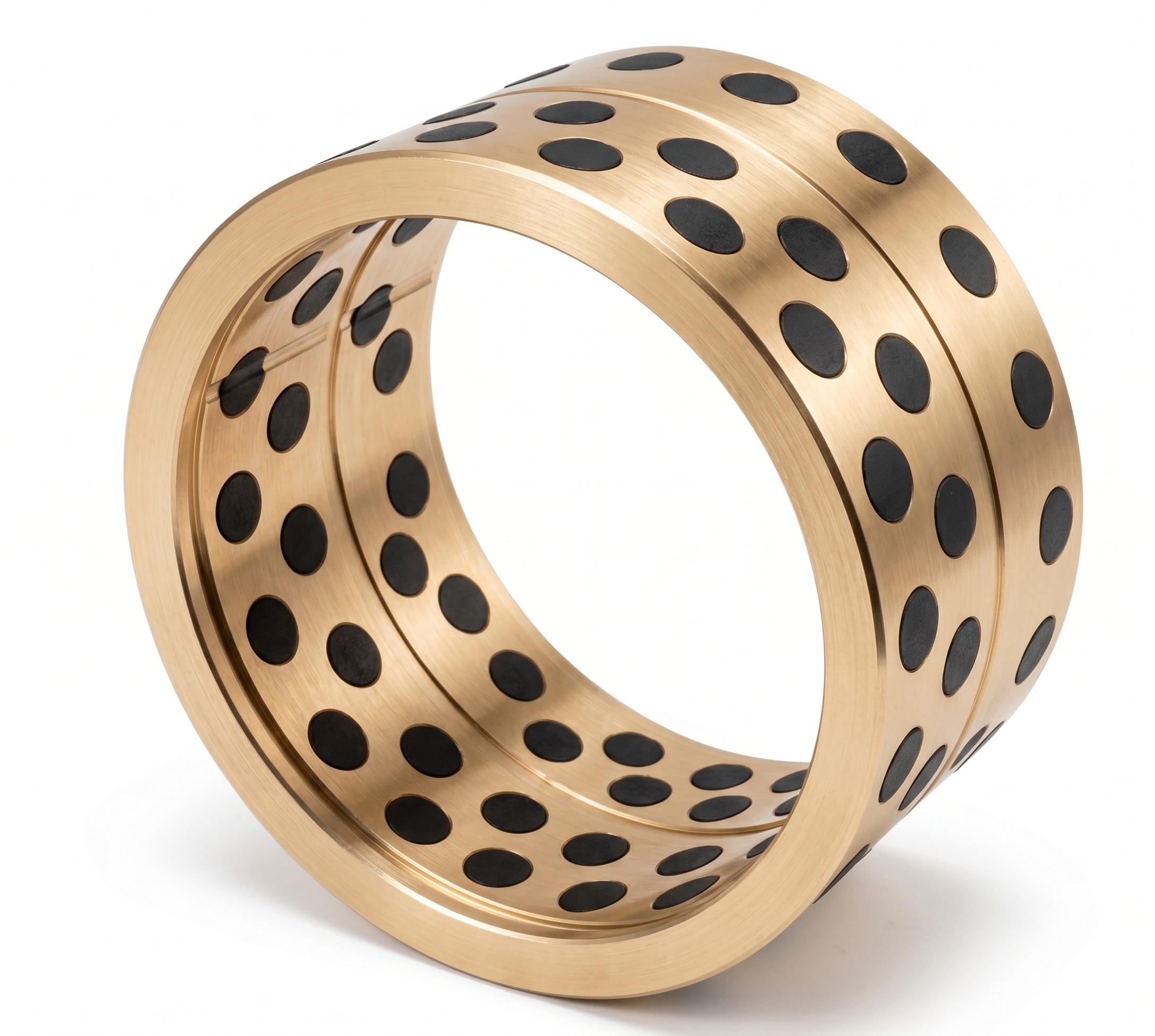
A significant advancement in bushing technology is the development of self-lubricating bushings. These bushings are designed to reduce friction without the need for external lubrication. Infused with materials like graphite or PTFE (Polytetrafluoroethylene), self-lubricating bushings release tiny amounts of lubricant during operation to ensure smooth movement. This not only cuts down on maintenance costs but also enhances the bushing’s performance in environments where traditional lubricants could attract dirt or degrade under extreme conditions.
Understanding Oilless Bushings
Oilless bushings are specialized bearings that let mechanical parts move smoothly without lubrication.

bushing definition, self-lubricating bushing
Small and often overlooked, bushings are vital to machinery’s efficiency and longevity. They reduce wear, prevent electrical hazards, and keep mechanical and electrical systems running smoothly. Whether they are standard or self-lubricating, these components ensure that machines operate smoothly, efficiently, and safely, marking their critical role in industrial and electrical applications.

Plain Bushings: Versatile for Rotary, Oscillating, and Linear Motion
Plain bushings, or plain bearings, silently keep mechanical systems running smoothly. Though best known for rotary or oscillating duties in engines and hinges, they also guide precise linear strokes. This article examines the material and design advances that enable them to perform reliably in both motion types under varied conditions.
Browse our Services for Custom Self-lubricating Bearings
Browse our Services for Custom Self-lubricating Bearings
Browse our Services for Custom Self-lubricating Bearings
Browse our Services for Custom Self-lubricating Bearings
Browse our Services for Custom Self-lubricating Bearings




Enhance Your Machinery’s Lifespan
Reduce the need for frequent maintenance and costly lubricants with our high-quality self-lubricating bushings. Start saving today. Click here!
Revolutionize Your Operations with Smart Bushings
Embrace innovation with bushings designed to self-lubricate, ensuring optimal performance under any conditions. Discover the future of machinery maintenance!
Reliability Meets Innovation in Our Bushings
Experience unmatched reliability with our advanced self-lubricating bushings that adapt to your operational demands effortlessly. Learn more now!
Metal Bushing (Lubricated Metal) -Self-Lubricating Bushing Materials
Bushings are specialized, self-lubricating metal components widely utilized across various industries due to their durability and low maintenance requirements. Self-lubricating metal bushings are engineered to function without additional lubrication in numerous applications, thereby minimizing maintenance needs. These bushings are available in various series and configurations, such as flanged bushings and split bearings, to meet specific application requirements.
Metal-Polymer Anti-Friction Plain Bearings
Metal-Polymer Composite Self-lubricating Bushing Material
Steel Back + Porous Bronze Sinter + PTFE
