
The Unsung Hero of Heavy Machinery: A Deep Dive into Centrifugal Casting Shaft Sleeves
Discover why centrifugally cast bronze and high-leaded tin bronze shaft sleeves are critical for protecting heavy machinery. Learn about the benefits, materials, and applications.
In the world of heavy machinery, the most expensive and catastrophic failures often start with the smallest components. A massive crusher, a deep-sea marine vessel, or a power generation turbine can be brought to a grinding halt by one thing: excessive wear on a critical rotating shaft. Replacing a multi-ton, custom-engineered shaft is an exercise in extreme cost and crippling downtime.
But what if you could protect that vital asset with a component designed specifically to take the abuse? Enter the casting shaft sleeve. This component is the sacrificial hero of modern industry. And when it comes to producing the most reliable, durable, and effective sleeves, one manufacturing process and a specific family of materials stand out: Centrifugal Casting using Bronze & High-Leaded Tin Bronze Alloys. This guide will go beyond the basics, exploring why this specific combination is the gold standard for industries that can’t afford to fail.
Get Instant Quote
To get your instant quote, just send your drawings file and select your production process and material.
Place Order
After placing your order, production will start. You’ll receive regular status updates.
Receive Parts
We provide quality assurance, quality reports, and delivery tracking.
Our complete product range, Plain bushings bronze, maintenance-free, Customized plain bearings to deliver optimal performance
Our slide bearings at a glance.
What is a Shaft Sleeve, and Why is it Essential?
At its core, a shaft sleeve is a cylindrical metal part fitted over a section of a rotating shaft. Its primary job is simple but critical: to be a renewable wear surface.
Instead of the shaft itself wearing down from friction, abrasion, or corrosion caused by bearings, packings, or seals, the sleeve takes the damage. When the sleeve is worn, it can be replaced relatively quickly and inexpensively, restoring the machine to its original specifications without needing to replace the entire casting shaft.
The Core Benefits of a Shaft Sleeve:
-
Massive Cost Savings: A replacement sleeve costs a tiny fraction of a new shaft.
-
Drastically Reduced Downtime: Swapping a sleeve takes hours, not the days or weeks required for a full shaft replacement and realignment.
-
Extended Equipment Lifespan: By protecting the core component, sleeves ensure your capital equipment runs for decades.
-
Simplified Maintenance: They are a predictable and planned maintenance item, not an emergency repair.
The Casting Method Matters: Why Centrifugal Casting is Superior
Not all casting sleeves are created equal. The manufacturing method directly impacts the sleeve’s integrity and performance. While methods like sand casting have their place, centrifugal casting is the undisputed champion for high-performance cylindrical parts.
In centrifugal casting, molten bronze is poured into a rapidly spinning die. The intense G-forces (often hundreds of times the force of gravity) press the metal against the die wall, creating a part with a fundamentally superior structure.
Let’s contrast the methods:
| Feature | Centrifugal Casting | Sand Casting (Static Casting) |
| Grain Structure | Fine, dense, and uniform. The rapid, directional solidification creates a highly organized microstructure. | Coarser, less uniform grain structure. Prone to variations. |
| Purity & Integrity | Extremely clean. Lighter impurities and trapped gases are forced to the inner diameter, where they are machined away. | Higher risk of porosity, sand inclusions, and gas pockets trapped within the casting. |
| Mechanical Strength | Significantly higher tensile strength, yield strength, and durability due to its dense, defect-free structure. | Lower mechanical properties. Weak points can form around impurities. |
| Machinability | Excellent and predictable. The uniform structure allows for smoother cuts, tighter tolerances, and a superior surface finish. | Can be unpredictable. Hitting a pocket of porosity or a hard inclusion can damage tools and ruin the finish. |
The Takeaway: A centrifugally cast sleeve is stronger, purer, and more reliable from the start. It will withstand higher loads and wear more predictably than a sleeve made by any other casting method.
Materials That Stand Up to Wear: Bronze and High-Leaded Tin Bronze
Choosing the right material is just as crucial as the casting method. Bronze alloys are the go-to choice for shaft sleeves due to their unique combination of toughness, corrosion resistance, and excellent bearing properties. As leaded bronze specialists, we guide our clients to the perfect alloy for their application.
Standard Tin Bronze (e.g., C90700)
Often called “gear bronze,” this alloy is a workhorse known for its high strength and good wear resistance. It’s an excellent choice for applications with high loads and adequate lubrication.
High-Leaded Tin Bronze Alloys (e.g., C93200, C93700)
This is where performance gets specialized. The “secret ingredient” is lead. In these alloys, the lead is not fully dissolved but exists as microscopic particles distributed throughout the bronze matrix. This provides two incredible benefits:
-
Self-Lubrication: Under pressure and friction, a tiny amount of lead is drawn to the surface, creating a thin, slippery film. This provides critical protection during start-up, shutdown, or in instances of intermittent lubrication failure.
-
Embeddability & Conformability: The soft lead particles can absorb small, abrasive contaminants (like dirt or metal filings) that would otherwise score and destroy the main shaft. The material can also “conform” slightly to minor misalignments, distributing load more evenly.
Here’s a breakdown for easier selection:
| Alloy | Key Characteristics | Best Use Cases |
| C90700 Tin Bronze | High strength, high hardness, good wear resistance. Requires reliable lubrication. | Heavy-load, low-speed applications. Gears, worm wheels, heavy-duty bushings. |
| C93200 Leaded Bronze | The “All-Rounder.” Excellent machining, good hardness and strength, fair corrosion resistance, and great anti-friction properties. | General purpose bushings and sleeves, pumps, light-duty applications. The industry standard. |
| C93700 High-Leaded Tin Bronze | The “Problem Solver.” Superior self-lubricity and embeddability. Excellent for high-speed applications or those with boundary lubrication. | High-speed turbine sleeves, pump sleeves, applications where lubrication might be compromised or abrasive particles are present. |
Your Durable Bronze Bearings Liner Source
Highlighting the Manufacturing Method: Static Casting: Static Casting: This is a traditional and reliable manufacturing process where molten metal is poured into a stationary mold and allowed to cool. For parts like bushings, it produces a solid, dense, and strong component, which is exactly what you need for a hard-wearing application.
POM composite bushings
Metal-Polymer Composite Bushing Material
Steel Back + Porous Bronze Sinter +
POM with Lubrication Indents
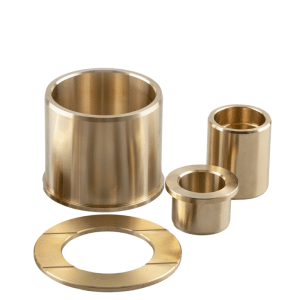
Solid bronze bushings
Cast Bronze Bushings with Solid Lubricant Inserts, Glide plate bronze, maintenance-free


casting sleeve, Materials that stand up to wear, casting shaft, casting sleeve, bronze machine, leaded bronze specialists
Ready to fortify your machinery against wear and tear? Contact our engineering team today to discuss your specific application and find the perfect centrifugal casting shaft sleeve solution.


Your Heavy Machinery Shaft Sleeve Source
When sourcing a component this critical, you need more than just a supplier; you need a partner. A true heavy machinery shaft sleeve source and leaded bronze specialist will provide:
-
Metallurgical Expertise: Guiding you to the precise alloy that matches your load, speed, and environmental conditions.
-
Proven Centrifugal Casting Capability: Ensuring the sleeve has the superior material properties needed to perform.
-
Precision Machining: Delivering a finished part that meets your exact dimensional tolerances for a perfect fit.
-
Quality Assurance: Full traceability and material certifications to guarantee you’re getting what you paid for.
Don’t let shaft wear be the weak link in your operation. Investing in a high-quality, centrifugally cast bronze shaft sleeve isn’t an expense—it’s insurance for your most valuable assets.
Uses for Shaft Sleeves: Powering Critical Industries
The need for reliable shaft protection is universal across heavy industry. If it rotates under load, it likely needs a shaft sleeve.
Here are just a few industries that depend on high-quality centrifugally cast casting sleeves:
- Mining & Construction Equipment: In massive rock crusher parts and excavators, sleeves on eccentric shafts withstand immense shock loads and abrasive dust.
- Oil & Gas: Downhole drilling equipment and industrial pumps rely on sleeves to handle corrosive fluids and high pressures.
- Marine: Propeller shafts, rudder stocks, and on-deck machinery require sleeves with exceptional resistance to saltwater corrosion.
- Power Generation: Turbine shafts and generator components spin at incredible speeds, demanding the self-lubricating properties of high-leaded bronze.
- Industrial Pumps: Sleeves protect the shaft from wear caused by packing and mechanical seals, preventing leaks and failure.
- Heavy Equipment & Infrastructure: Cranes, presses, and movable bridges all utilize sleeved shafts in their core mechanics.
- Architectural Bronze Castings: While often decorative, large-scale moving architectural features (like kinetic sculptures or operable doors) use bronze sleeves for smooth, long-lasting movement.
Browse our Services for Custom Self-lubricating Bearings
Browse our Services for Custom Self-lubricating Bearings
Browse our Services for Custom Self-lubricating Bearings
Browse our Services for Custom Self-lubricating Bearings
Browse our Services for Custom Self-lubricating Bearings
