


PTFE Bushings vs Bronze : What’s the Difference?
PTFE bushings are a good choice for applications where self-lubrication, temperature resistance, and wear resistance are important factors, while bronze bushings are a good choice for heavy-duty applications where high load capacity is needed. Ultimately, the choice between PTFE bushings and bronze bushings will depend on the specific application and the requirements of that application.

Bearings and Bushings
Maintenanceof Bearings and Bushings
Bearings and bushings play a vital role in various industrial applications, and choosing the right one for your application can be challenging. However, by understanding the types, materials, applications, and maintenance practices of bearings and bushings, you can make an informed decision and ensure optimal performance and longevity. Whether you are in the automotive, aerospace, machinery, or construction industry
A Guide to Bearings and Bushings
Bearings and bushings are crucial components in many industrial applications, such as machinery, automobiles, and aerospace. They provide support and enable motion between parts, reducing friction and wear. However, selecting the right bearing or bushing can be challenging due to the variety of types available. This guide covers the types, materials, applications, and maintenance of bearings and bushings.
Types of Bearings
Bearings are categorized by design, load capacity, and application. Common types include:
- Ball Bearings: Use balls to reduce friction and facilitate motion. Ideal for high-speed, low-friction applications.
- Roller Bearings: Use cylindrical or tapered rollers to support radial and axial loads. Suitable for heavy loads, high speeds, and precise alignment.
- Thrust Bearings: Handle axial loads, such as those in gearboxes or steering systems. Available in ball, roller, and needle designs.
- Plain Bearings (Bushings): Use a sliding surface, like PTFE, to reduce friction. Perfect for high shock resistance, low noise, and long service life.
Materials Used in Bearings
Bearings and bushings are made from various materials based on application requirements:
- Steel: Commonly used for its strength, durability, and corrosion resistance.
- Ceramic: Suitable for high speeds, high temperatures, and wear resistance.
- Polymer: Lightweight, corrosion-resistant, and self-lubricating. Ideal for food and beverage applications.
- Bronze: Used for high shock resistance, low wear, and low friction.
Applications of Bearings and Bushings
Bearings and bushings are utilized across various industries:
- Automotive: Found in engines, gearboxes, and wheels.
- Aerospace: Used in landing gear, engines, and flight controls.
- Machinery: Essential in pumps, compressors, and turbines.
- Construction: Utilized in equipment like excavators, bulldozers, and cranes.
Maintenance of Bearings and Bushings
Proper maintenance ensures the longevity and performance of bearings and bushings. Key practices include:
- Lubrication: Reduces friction and wear. The type and amount depend on the application.
- Inspection: Regular checks can detect wear or damage and prevent failures.
- Replacement: Damaged or excessively worn bearings and bushings should be replaced promptly to avoid further damage.
Composite Bushing PTFE Steel Self-Lubricating: The Ultimate Solution for High-Performance Applications
PTFE Bushings vs Bronze : What’s the Difference?
Composite bushings and bronze bushings are two common types of bushings used in various applications. Here are some key differences between the two:
- Material: Composite bushings are made of polytetrafluoroethylene (PTFE), which is a synthetic polymer. Bronze bushings are made of a copper and tin alloy.
- Lubrication: Composite bushings are self-lubricating and do not require additional lubrication, while bronze bushings often require lubrication to reduce friction and wear.
- Wear Resistance: PTFE bushings are highly resistant to wear and can last a long time even under heavy loads, while bronze bushings are more susceptible to wear and may need to be replaced more frequently.
- Load Capacity: Bronze bushings generally have a higher load capacity than PTFE bushings, making them suitable for heavy-duty applications.
- Temperature Resistance: PTFE bushings have a higher temperature resistance than bronze bushings, making them suitable for applications in high-temperature environments.
- Cost: PTFE bushings are often more expensive than bronze bushings.

In industries where high-performance and reliability are paramount, the selection of the right bushing material is critical to the success of machinery and equipment.
Composite bushing PTFE steel self-lubricating bushings have emerged as a go-to solution for engineers and designers looking to optimize the performance of their applications. This article will delve into the features and benefits of these bushings and explore why they are a preferred choice in various industries.
Understanding Composite Bushing PTFE Steel Self-Lubricating Bushings
Composite bushing PTFE steel self-lubricating bushings are composite bushings made up of a steel backing and a PTFE (polytetrafluoroethylene) layer. This unique combination provides exceptional wear resistance, low friction, and self-lubricating properties. The steel backing ensures durability and strength, while the PTFE layer acts as a solid lubricant, eliminating the need for external lubrication.
Advantages of PTFE Bushing PTFE Steel Self-Lubricating Bushings
- Low Friction: PTFE, commonly known as Composite, is renowned for its low friction coefficient, making it an ideal material for bushings. The low friction helps reduce wear and tear on the mating surfaces, recognized to longer service life and reduced maintenance costs.
- Self-Lubricating: The PTFE layer functions as a solid lubricant, eliminating the need for additional greasing. This self-lubricating property simplifies maintenance procedures and reduces the risk of machinery failure due to inadequate lubrication.
- High-Temperature Resistance: PTFE has excellent thermal stability, making Composite bushing PTFE steel self-lubricating bushings suitable for applications with elevated temperatures. These bushings can withstand temperatures ranging from -200°C to +260°C, ensuring reliable performance in extreme conditions.
- Chemical Resistance: PTFE is highly resistant to chemicals, making these bushings ideal for use in corrosive environments or applications involving exposure to harsh chemicals.
- Versatility: bushing PTFE steel self-lubricating bushings are available in various sizes and shapes, making them suitable for a wide range of applications across multiple industries.
Applications of Bushing PTFE Steel Self-Lubricating Bushings
Due to their unique properties, bushing PTFE steel self-lubricating bushings find applications in numerous industries, including:
- Automotive: In the automotive industry, these bushings are used in suspension systems, steering systems, and transmission components, contributing to smoother vehicle operation and reduced maintenance requirements.
- Food and Beverage: The chemical resistance and self-lubricating properties of these bushings make them suitable for use in food processing equipment, where cleanliness and hygiene are critical.
- Aerospace: The high-temperature resistance and low friction of these bushings make them a popular choice for aircraft components, such as landing gear assemblies and flight control systems.
- Industrial Machinery: Composite bushing PTFE steel self-lubricating bushings are commonly found in heavy machinery, including construction equipment, mining machinery, and agricultural equipment, where they help enhance performance and reduce downtime.
Conclusion
Composite bushing PTFE steel self-lubricating bushings offer an exceptional combination of low friction, self-lubrication, high-temperature resistance, and chemical resistance, making them a top choice for engineers and designers in various industries. By incorporating these bushings into their designs, manufacturers can significantly improve the performance, reliability
Composite Self-lubricating Bearing Bush

When it comes to selecting a suitable bushing for a specific application, one of the most important factors to consider is the type of lubrication system to be used. Traditional bushings rely on external lubrication to reduce friction and prevent wear and tear. However, this approach can lead to several issues, such as contamination of the lubricant, lubrication failure due to inadequate maintenance, and high operating costs.
To overcome these problems, self-lubricating bushings have been developed that rely on internal lubrication. One of the most effective and widely used self-lubricating materials is PTFE (polytetrafluoroethylene), commonly known as Composite. In this article, we will discuss
Composite self-lubricating steel bushings in detail, including their properties, advantages, and applications.
Properties of Self-Lubricating Steel Bushings
Composite self-lubricating steel bushings consist of a steel backing with a porous sintered bronze layer that is impregnated with PTFE. This combination of materials provides several advantages over traditional lubricated bushings. Some of the key properties of ptfe self-lubricating steel bushings are:
- Low friction coefficient: Composite has one of the competitive coefficients of friction among all known solid materials, making it an excellent choice for applications where low friction is critical.
- High wear resistance: PTFE is a highly durable material that can withstand wear and tear even under heavy loads and high speeds.
- Chemical resistance: PTFE is resistant to a wide range of chemicals, making it suitable for use in harsh environments.
- Self-lubricating: PTFE has a low surface energy, which allows it to retain and release lubricant over time, ensuring a continuous supply of lubrication to the bushing.
Advantages of PTFE Self-Lubricating Steel Bushings
The use of PTFE self-lubricating steel bushings provides several advantages over traditional lubricated bushings. Some of the key advantages are:
- Maintenance-free operation: self-lubricating steel bushings require no external lubrication, which means they can operate maintenance-free for extended periods.
- Reduced operating costs: Since self-lubricating steel bushings do not require external lubrication, there is no need for frequent lubrication changes, reducing operating costs.
- Improved performance: self-lubricating steel bushings offer low friction and high wear resistance, resulting in improved performance and longer service life.
- Lower noise levels: self-lubricating steel bushings generate less noise than traditional lubricated bushings, making them suitable for applications where noise reduction is critical.
Applications of Composite Self-Lubricating Steel Bushings
self-lubricating steel bushings are widely used in various industrial applications due to their excellent properties and advantages. Some of the most common applications of
Composite self-lubricating steel bushings are:
- Automotive industry: self-lubricating steel bushings are used in various automotive applications, such as suspension systems, steering columns, and clutch release bearings.
- Aerospace industry: self-lubricating steel bushings are used in aircraft landing gear, flap tracks, and control surface bearings.
- Food industry: self-lubricating steel bushings are used in food processing and packaging equipment, where lubrication contamination is a concern.
- Construction industry: self-lubricating steel bushings are used in construction equipment
Bushing vs. Bronze Bearings
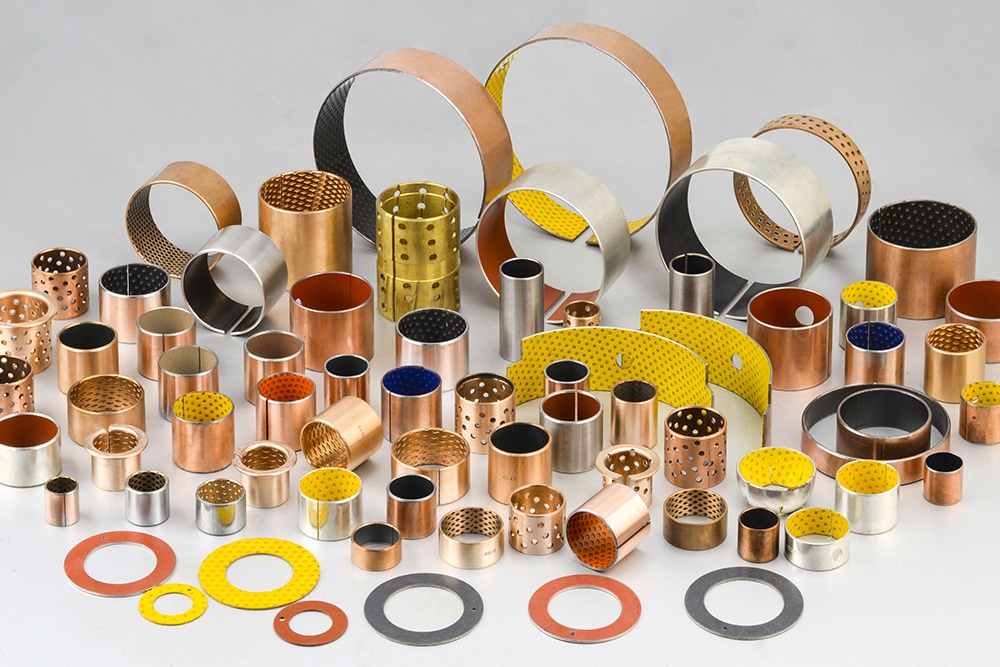
Engineered composite n Bushing has been proven to last longer than oil-impregnated sintered bronze bearings, saving users up to 60% in maintenance costs. Bushing has replaced bronze in thousands of applications in a wide variety of industries, including agricultural machinery, lawn mowers, medical equipment, food processing machinery, fitness equipment, and pumps and valves.
Bushing Bushing Construction
steel backed bronze with PTFE
Bushing with bronze bearing
Bushing vs. bronze bushing
However, Composite Bushing bushings are injection molded from a blend of base polymer, composite sliding lubricant material, and solid lubricant. The composite self-lubricating material maintains the bearing’s strength and resistance to high forces and edge loading. When motion occurs, a very small amount of solid lubricant is released into the micromachining of the shaft to help reduce the coefficient of friction.
Composite Bushing material can also withstand high temperatures and high load carrying for up to short periods of time.
Other benefits include low wear rates, quiet operation, high load capacity, and resistance to chemicals, dust, UV and corrosion. A wide variety of
Composite Bushing bushing materials are available to meet the requirements of virtually any application.
Choosing the right shaft for your bearing material is critical, as bearing life is affected by relative motion.
Rough shafts are too abrasive and will slowly wear the bearing surface in motion. A very smooth shaft will result in a higher wear rate because proper lubrication of the shaft can be a challenge.
Bushing Application Temperature

Oil platform under maintenance. Bergen, Norway.
The minimum application temperature is the temperature below which the material becomes so hard that it is too brittle for standard applications. Maximum continuous application temperature is the temperature at which the material can withstand without significant change in its properties. The maximum temperature for short-term applications is the temperature above which the material becomes so soft that it can only withstand lower external loads. Short-term” is defined as a time period of a few minutes. If the bushing is moved axially or if axial forces occur, there is more chance that the bushing will lose its compression properties. In these cases, axial fixation of the bushing is also required.
Composite Bushing Bearing has a maximum ambient temperature to which it can be exposed in a short period of time. If these temperatures are reached, the bushing may not be subjected to additional loading. In fact, at these temperatures, the bushing will relax even without additional loading. For this reason, it is necessary to ensure that the bushing cannot slip out of the bore. This can be achieved by changing the structure of the bore or by fixing the bushing additionally. Composite bushings have a maximum ambient temperature that they can tolerate for a short period of time. If these temperatures act on the bushing, no additional pressure should be applied to it. At these temperatures, the bushings in the housing can relax even without any additional load. Care should be taken to ensure that the ptfe bushings do not slip out of the bore by changing the construction of the bore or by additionally securing the bushings.
Composite coating process for steel bushings:

- Preparation: Before applying the ptfe coating, it is important to properly prepare the surface of the steel bushings. This typically involves cleaning the bushings to remove any contaminants, such as dirt, grease, or oil. Depending on the specific requirements, this can be done using a solvent or alkaline cleaner, followed by rinsing with water and drying.
- Surface roughening: To promote adhesion, the surface of the steel bushings may need to be roughened. This can be accomplished through methods such as sandblasting, grinding, or etching. The goal is to create a rough surface that will enable the PTFE coating to bond securely to the bushings.
- Application of the PTFE coating: The PTFE coating can be applied using various methods, including spraying, dipping, or brushing. The choice of method will depend on the desired thickness and uniformity of the coating, as well as the specific type of Composite being used. It is important to apply the coating evenly to ensure consistent performance across the entire surface of the bushings.
- Curing: Once the PTFE coating has been applied, it must be cured to develop its full set of properties. Curing typically involves heating the coated bushings to a specific temperature for a predetermined amount of time. The curing process helps the PTFE coating to adhere to the steel bushings and achieve its optimal performance characteristics.
- Inspection and testing: After the curing process is complete, the PTFE-coated steel bushings should be inspected for any defects or inconsistencies. Tests may be conducted to verify that the coating meets the desired performance criteria, such as friction and wear resistance.
PTFE-coated steel bushings are commonly used in various industries, including automotive, aerospace, and manufacturing, due to their ability to reduce friction, resist wear, and withstand harsh environments. The PTFE coating can significantly extend the life of the bushings and reduce the need for maintenance or replacement, ultimately saving time and money.
Composite bushes, also known as PTFE (polytetrafluoroethylene) bushes, are self-lubricating, low-friction components used in various industries, including automotive, aerospace, and manufacturing. They are popular due to their durability, resistance to chemicals and heat, and low maintenance requirements. This summary provides an overview of Composite bushes, their properties, applications, and advantages.
Properties of Bushes:
- Low Friction: Composite bushes have an exceptionally low coefficient of friction, making them ideal for applications requiring minimal friction and smooth movement.
- Self-Lubricating: These bushes are self-lubricating, eliminating the need for additional lubricants and reducing maintenance costs.
- High-Temperature Resistance: Composite bushes can withstand high temperatures, typically up to 500°F (260°C), making them suitable for use in high-temperature applications.
- Chemical Resistance: PTFE is chemically inert, meaning it is resistant to most chemicals, including acids, bases, and solvents.
- Non-Stick: Composite’s non-stick surface ensures easy release of materials, reducing the risk of product buildup and contamination.
- Electrical Insulation: PTFE has excellent dielectric properties, making it suitable for use as an insulating material in electrical applications.
- Dimensional Stability: Composite bushes maintain their shape and dimensions under varying temperature and pressure conditions, ensuring consistent performance.
- Wear Resistance: These bushes are resistant to wear and abrasion, which contributes to their long service life.
Applications of Composite Bushes:
- Automotive Industry:
Composite bushes are used in various automotive components, such as suspension systems, steering systems, and transmission parts, to reduce friction and wear.
- Aerospace Industry: PTFE bushes are used in aircraft components, such as landing gear, actuators, and control surfaces, for their low-friction, high-temperature resistance, and lightweight properties.
- Manufacturing Industry: PTFE bushes are used in machines and equipment, including conveyors, mixers, and packaging machinery, to ensure smooth, low-friction operation.
- Chemical Processing: Due to their chemical resistance, PTFE bushes are used in valves, pumps, and other equipment in the chemical processing industry to prevent corrosion and chemical reactions.
- Food and Beverage Industry: PTFE bushes are utilized in food processing equipment, such as mixers, slicers, and filling machines, for their non-stick and easy-to-clean properties.
- Electrical and Electronics Industry: PTFE bushes serve as insulators in electrical applications, such as transformers, switches, and connectors, due to their excellent dielectric properties.
Advantages of PTFE Bushes:
- Reduced Maintenance: The self-lubricating nature of PTFE bushes eliminates the need for additional lubrication, reducing maintenance costs and downtime.
- Increased Lifespan: The wear-resistant properties of PTFE bushes contribute to their long service life, reducing the need for frequent replacement.
- Enhanced Performance: The low-friction properties of PTFE bushes enable smooth, efficient operation in various applications, recognized to improved overall performance.
- Versatility: PTFE bushes can be used in a wide range of industries and applications, making them a versatile and cost-effective solution.
- Environmentally Friendly: The use of PTFE bushes can help reduce environmental impact by eliminating the need for lubricants and reducing wear-related waste.
In conclusion,
Composite bushes are valued for their unique properties, such as low friction, self-lubrication, and resistance to high temperatures and chemicals.

Sleeve bearing, mm
Low coefficients of friction in dry operation! Customizing steel PTFE (PTFE) bushes for specialized applications and industries. PTFE bushes are a type of bushing made from PTFE, a synthetic material known for its non-stick and low friction properties. PTFE bushes are commonly used in machinery and equipment to reduce friction between moving parts, improve efficiency, and reduce wear and tear.


Reliable & Safe PTFE- lined Bearings Supplier
Maintenance-Free Composite Bushings PTFE bushing Alternatives, Low Friction Bushing Increased Productivity


“Upgrade Your Ride with English Steel Composite Bushes”, Sourcing at viiplus.com
Contact us today
