
Viiplus.com flange sleeve bearing
Flange Sleeve Bearing
Flanges, also referred to as flange plates, connect pipe ends and facilitate connections between equipment at inlet and outlet points.
Flange bearings and bushings made from high-performance metals or self-lubricating bronze alloys offer secure and stable positioning while allowing for free rotational motion of the bearing unit. Metal Bronze Flange Bearing Custom Size Available!

Plain Sleeve and Flanged Bearings, Flanged Sleeve Bushings of Various Specifications, Enhance Technology & Reduce Costs
Flange sleeve bearings, also known as flange copper sleeves, can be either self-lubricating or not. Self-lubricating bearings can be flanged or unflanged and are designed based on specific usage requirements. Both flanged sleeves and self-lubricating bearings are types of sliding bearings, sharing this commonality. A flanged sleeve is an oil-free bushing with a flange at one end.
As industrial automation rapidly advances, there is a growing demand for efficient, environmentally friendly, convenient, and cost-effective self-lubricating bearing solutions. This drives VIIPLUS to innovate and produce cost-effective dry bearings and oilless bushings. These maintenance-free products are essential in the industry. Self-lubricating shaft sleeves and flange copper sleeves provide versatile solutions for indoor crane applications.
In certain industrial sectors, such as port machinery and container handling, self-lubricating and oil-free bearings offer high cost performance.
To address specific applications, the VIIPLUS team has developed the self-lubricating bronze flange bushing. Flange sleeve copper sleeves utilize self-lubricating graphite and other materials, maximizing their lubricating capabilities for fixed use.
With a minimal structure, composite bushings and bimetal flange bushings are highly efficient and maintenance-free, simplifying operations. Traditional bearing refueling can disrupt normal function, but the oilless flange bushing system avoids this issue, ensuring smooth operation even at low altitudes.
These solutions require minimal installation time and significantly reduce the material costs of self-lubricating copper sleeves. Their applications extend beyond indoor cranes to port machinery, allowing for versatile overhead configurations. This addresses many challenges in the indoor crane sector, optimizing space utilization and installation efficiency while minimizing maintenance needs.
VIIPLUS continues to innovate and apply its expertise across various industries, focusing on advanced technology, cost reduction, and reliability in self-lubricating bearings.

Flange Bearings
Plain Sleeve & Flanged Bearings
We offer plain bearings categorized by product type, flange diameter, brand, brushing type, and material.
Standard copper sleeves, both with and without flanges, are selected based on specific models for various working conditions. Important considerations include pressure, speed, pressure-speed product, lubrication state, and load characteristics.
The movement and axial sliding requirements of flange bronze bushings significantly influence lubricating oil performance, while the bushing’s lifespan is primarily affected by speed and pressure.
Centrifugal casting of copper sleeves and bearing bushes provides superior compactness, wear resistance, tensile strength, flexural strength, and tensile rate compared to sand casting.
Steel Backed PTFE Lined Inch Flanges
PTFE OR POMcomposite flanged bushing
High-performance metal polymer flange bearings and bushings enable secure positioning while allowing free rotation. PTFE composite flanged bushings are ideal for oscillating, rotating, and linear movements, accommodating both radial and axial loads.These engineered components are designed to withstand extreme conditions, offering exceptional wear resistance and reducing friction to prolong service life. The unique composition of the PTFE matrix provides a low coefficient of friction, making these bearings suitable for high-speed applications where traditional materials may fail. Furthermore, their resistance to chemicals and environmental factors ensures reliable performance in diverse settings, from heavy machinery to delicate instrumentation.
In applications requiring precise alignment and stability, the integration of high-performance metal polymer flanges enhances structural integrity, minimizing the risk of misalignment. This feature is crucial in dynamic environments, where consistent performance is paramount. The versatility of these bearings allows them to be employed across a wide range of industries, including automotive, aerospace, and manufacturing, thereby ensuring optimal functionality in every application.
Additionally, the lightweight nature of these components further contributes to energy efficiency, facilitating smoother operation while reducing the overall system load. By choosing high-performance metal polymer flange bearings and bushings, engineers and designers can achieve innovative solutions that meet the demands of modern engineering challenges.

Curabitur non nulla sit amet nisl tempus.
Installation Note for Flange Copper Sleeve
The flange copper sleeve, made of copper, is larger and significantly increases the weight of the flange copper set, making installation challenging. Care must be taken during installation; it should not be forced or struck with a hammer. Choosing the right tools is essential for proper installation. Additionally, the cleanliness of the installation environment directly impacts the success of the installation and the sleeve’s service life.
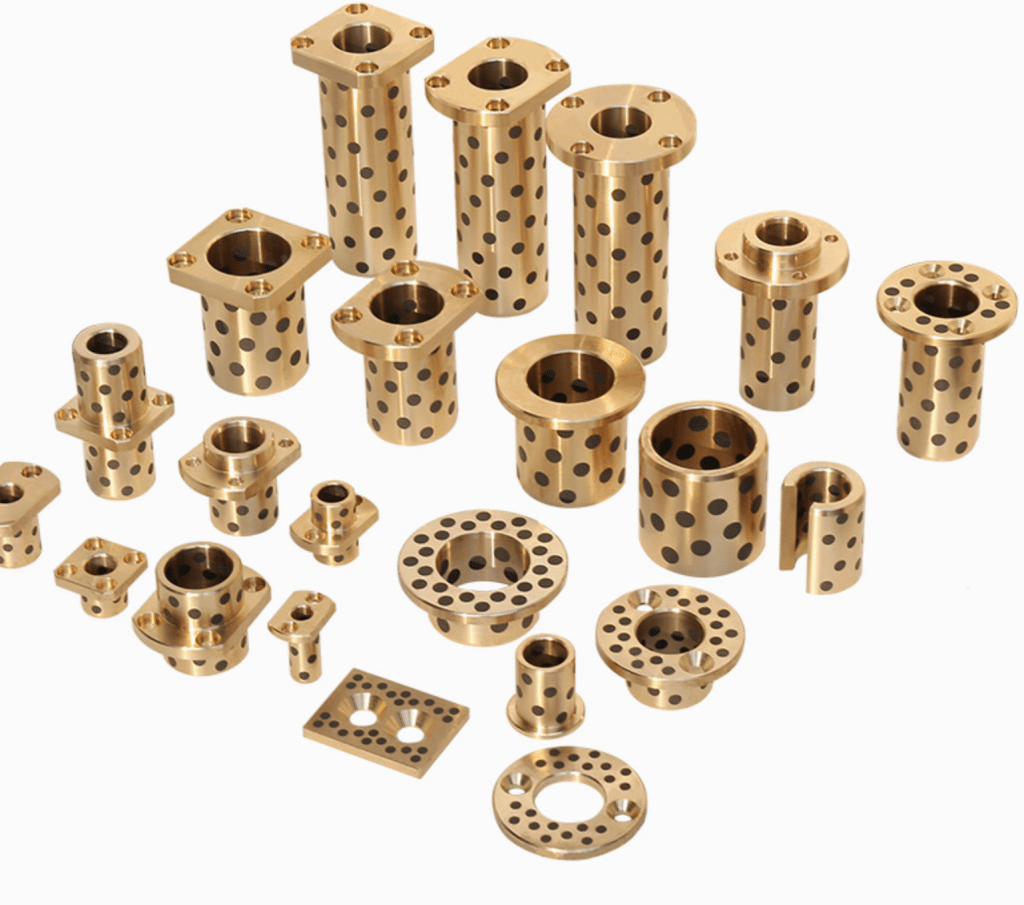

Industrial Bushings and Flange Sleeve Bearings Available at Viiplus.com
Production Process of Flange Sleeve Bearings
1. Mix materials as per customer specifications and send to the intermediate frequency furnace for smelting.
2. Perform spectral furnace analysis before pouring.
3. Adjust metal element additions based on spectral analysis results to meet customer material requirements.
4. Carry out centrifugal casting of copper sleeves.
5. Conduct mechanical processing.
6. Test mechanical properties, including tensile and hardness tests.
7. Perform non-destructive testing to ensure no casting defects.
8. Package and deliver goods after inspection.

