
Unlock Efficiency: A Deep Dive into Maintenance-Free Sliding Bearings
In the demanding world of engineering and machinery, downtime is the enemy. Traditional lubricated bearings, while effective, require regular maintenance – greasing schedules, lubricant checks, and the associated labor costs. What if you could eliminate this recurring task, reduce operational expenses, and increase reliability, especially in hard-to-reach or harsh environments? Enter maintenance-free sliding bearings.
These aren’t just components; they are solutions designed to operate smoothly and reliably without the need for external lubrication throughout their service life. Let’s move beyond the surface level and explore the technology, materials, and types that make maintenance-free operation a reality.

Get Instant Quote
To get your instant quote, just send your drawings file and select your production process and material.
Place Order
After placing your order, production will start. You’ll receive regular status updates.
Receive Parts
We provide quality assurance, quality reports, and delivery tracking.
Our complete product range, sliding bearing and plain bushing, maintenance-free
Our sliding bearings at a glance.
What Makes a Sliding Bearing “Maintenance-Free”?
The core principle is self-lubrication. Unlike bearings requiring periodic grease or oil application, maintenance-free types have lubrication built-in or possess inherent low-friction properties. This is achieved through several mechanisms:
-
Low-Friction Materials: Utilizing polymers like PTFE (Polytetrafluoroethylene) known for their extremely low coefficient of friction.
-
Solid Lubricants: Embedding materials like graphite, MoS2 (Molybdenum disulfide), or PTFE directly into the bearing structure. These lubricants transfer to the mating surface during operation, creating a self-sustaining lubricating film.
-
Material Properties: Employing specific metal alloys or composites that offer good sliding properties without galling, often combined with one of the above methods.
Exploring Key Types of Maintenance-Free Sliding Bearings
The term “plain bearing” or “bushing” simply describes a sleeve-like component allowing relative motion. Making them maintenance-free involves specific materials and construction. Let’s break down the types you mentioned:
1. Multi-Layer Composite Bearings (e.g., Metal-Polymer)
Often considered the workhorse of maintenance-free bearings, these sophisticated components typically feature:
-
Steel Backing: Provides high mechanical strength, load-carrying capacity, and ensures a press-fit installation.
-
Sintered Bronze Interlayer: Porous bronze powder sintered onto the steel backing. This layer serves multiple purposes:
-
Strongly bonds the sliding layer to the steel back.
-
Conducts heat away from the sliding surface.
-
Acts as a reservoir for the polymer/lubricant mixture.
-
-
Sliding Layer (e.g., PTFE-based): A precise mixture (often PTFE and fillers) is impregnated and overlaid onto the bronze layer. During initial run-in, a thin film of this low-friction material transfers to the mating shaft, creating an optimal sliding surface.
Key Advantage: Excellent balance of low friction, high load capacity, wear resistance, and relatively wide temperature range.
2. Metal-Backed Bronze Bushings (Steel-Backed Bronze)
These bearings leverage the strength of steel with the bearing properties of bronze.
-
Structure: A layer of bronze powder (often leaded bronze for lubricity or lead-free alternatives) is sintered onto a steel backing.
-
Maintenance-Free Aspect: To be truly maintenance-free, these often rely on:
-
Impregnation: The porous bronze layer can be impregnated with oil during manufacturing (providing lubrication for life in some sealed or low-duty applications, often termed “pre-lubricated”).
-
Indentations/Pockets: Some designs feature patterns pressed into the bronze layer, filled with solid lubricants or designed to retain grease for extended periods (though the latter might be considered “low-maintenance” rather than strictly “maintenance-free”).
-
PTFE/Polymer Layer: Similar to multi-layer bearings, a polymer layer can be added over the sintered bronze for true self-lubrication.
-
Distinction: A simple steel-backed sintered bronze bearing without impregnation or a self-lubricating overlay generally requires lubrication. The “maintenance-free” designation depends on these added features.
3. Self-Lubricating Bronze Bushings with Solid Lubricant
These are typically robust bearings designed for demanding conditions:
-
Structure: Machined or cast from solid bronze alloys (like Tin Bronze, Aluminum Bronze, or Manganese Bronze). Precisely spaced holes or grooves are drilled/machined into the bearing surface and plugged with solid lubricants (commonly graphite, sometimes PTFE or MoS2).
-
Mechanism: As the shaft rotates or slides, it makes contact with the solid lubricant plugs. Microscopic amounts of lubricant are continuously deposited onto the shaft and bearing surface, maintaining a low-friction film.
-
Characteristics:
-
Excellent for high loads and low speeds.
-
Can handle higher temperatures than many polymer-based bearings.
-
Good resistance to contamination and edge loading.
-
The base bronze provides high structural integrity.
-
4. Bronze Bushings: Rolled vs. Turned
Bronze bushings can be manufactured in different ways, impacting their properties and suitability for maintenance-free designs:
-
Rolled Bronze Bushings (Wrapped Bronze):
-
Process: Made by rolling a flat strip of bronze alloy (e.g., CuSn8) into a cylindrical shape. They often feature diamond or spherical indentations on the surface.
-
Hot-Rolled vs. Cold-Rolled:
-
Hot-Rolled: Processed at high temperatures. Generally results in lower internal stresses, potentially better toughness, but might have less precise tolerances and a coarser grain structure.
-
Cold-Rolled: Processed at or near room temperature. Increases hardness and strength (work hardening), allows for tighter tolerances and smoother surface finishes. Often preferred for precision bearing applications.
-
-
Maintenance-Free Application: These indentations are crucial. They act as reservoirs for grease in traditional applications. For maintenance-free or low-maintenance use, they can sometimes be filled with solid lubricants or designed to work with specific self-lubricating bronze alloys, or operate dry for short periods under light loads. Many wrapped bushings are designed for initial greasing and long lubrication intervals rather than being truly maintenance-free unless specifically engineered (e.g., with a PTFE layer bonded inside).
-
-
Turned Bronze Bushings (Machined/Solid Bronze):
-
Process: Machined from solid bronze bar stock or castings. Allows for complex shapes, custom dimensions, and high precision.
-
Maintenance-Free Application: To be maintenance-free, they must either:
-
Be made from a specialized self-lubricating bronze alloy.
-
Incorporate solid lubricant plugs (like the Self-Lubricating Bronze Bushings described above).
-
-
Otherwise: Standard turned bronze bushings (e.g., from C93200 Bearing Bronze) require regular lubrication.
-
Comparison: Choosing the Right Maintenance-Free Bearing
Selecting the optimal bearing requires understanding the trade-offs:
| Feature | Multi-Layer Composite (e.g., PTFE-lined) | Steel-Backed Sintered Bronze (Impregnated/Filled) | Solid Bronze with Solid Lubricant Plugs | Rolled Bronze (Specifically designed Maintenance-Free variants) |
| Primary Mechanism | PTFE/Polymer Layer | Porous Bronze + Impregnant/Filler | Solid Lubricant Plugs in Bronze Matrix | Material Property / Indent Fillers / PTFE Layer |
| Load Capacity | High | Moderate to High | Very High | Moderate to High |
| Speed Limit (PV) | High | Moderate | Low to Moderate | Moderate |
| Temperature Range | Moderate (-200°C to +280°C typical) | Moderate (Depends on impregnant) | High (Base bronze limits) | Moderate (Depends on specific design) |
| Friction Coefficient | Very Low | Low to Moderate | Low | Low to Moderate |
| Dry Running Ability | Excellent | Good (if designed for it) | Excellent | Fair to Good (design dependent) |
| Contamination Resist. | Good (Sealed options available) | Fair | Good to Very Good | Fair (Indentations can trap debris if not sealed) |
| Cost (Relative) | Moderate | Low to Moderate | High | Low to Moderate |
| Typical Backing | Steel | Steel | N/A (Solid Bronze) | N/A (Solid Rolled Bronze) |
Note: PV Value (Pressure x Velocity) is a critical parameter indicating the bearing’s operational limits under load and speed. Higher PV generally means suitability for more demanding applications.
Benefits Beyond Reduced Maintenance
Choosing maintenance-free bearings offers significant advantages:
-
Lower Total Cost of Ownership (TCO): Eliminates lubricant costs, labor for greasing, and potential downtime costs associated with lubrication failures.
-
Increased Reliability & Uptime: Consistent performance without reliance on maintenance schedules.
-
Design Simplification: No need for grease nipples, lubrication lines, or reservoirs.
-
Environmental Friendliness: Reduces or eliminates lubricant leakage and disposal concerns.
-
Wider Operating Conditions: Suitable for environments where lubrication is difficult or impossible (vacuum, extreme temperatures, contamination).
-
Compact Designs: Often allows for smaller, lighter assemblies.
Applications Across Industries
Maintenance-free sliding bearings are found everywhere:
-
Automotive: Suspension joints, hinges, steering systems, pedals.
-
Industrial Machinery: Conveyors, packaging equipment, robotics, pumps, valves.
-
Construction & Agriculture: Pivot points on loaders, excavators, tractors.
-
Hydraulics & Pneumatics: Cylinder guides, rod ends, pump components.
-
Renewable Energy: Solar tracker mechanisms, wind turbine pitch/yaw systems.
Making the Right Choice: Key Considerations
Selecting the correct maintenance-free bearing involves analysing your application:
-
Load: Magnitude, direction (radial, axial, combined), static or dynamic?
-
Speed: Rotational speed (RPM) or linear speed (m/s)? Continuous or intermittent?
-
Motion Type: Rotating, oscillating, linear, or combined?
-
Temperature: Minimum, maximum, and typical operating temperatures?
-
Environment: Exposure to dirt, dust, moisture, chemicals, or corrosive agents?
-
Mating Surface: Shaft material, hardness, and surface finish are critical for performance and wear life.
-
Required Life: How many hours or cycles must the bearing endure?
-
Cost Constraints: Balancing initial cost versus long-term TCO.
Sliding Bearing Material, Cylindrical bushing and Flanged Bushing, Thrust washer
Maintenance-free sliding bearings represent a significant advancement over traditional lubricated components. By leveraging innovative materials like PTFE, solid lubricants such as graphite, and advanced manufacturing techniques like sintering and multi-layer construction, they offer unparalleled reliability and reduced operating costs.
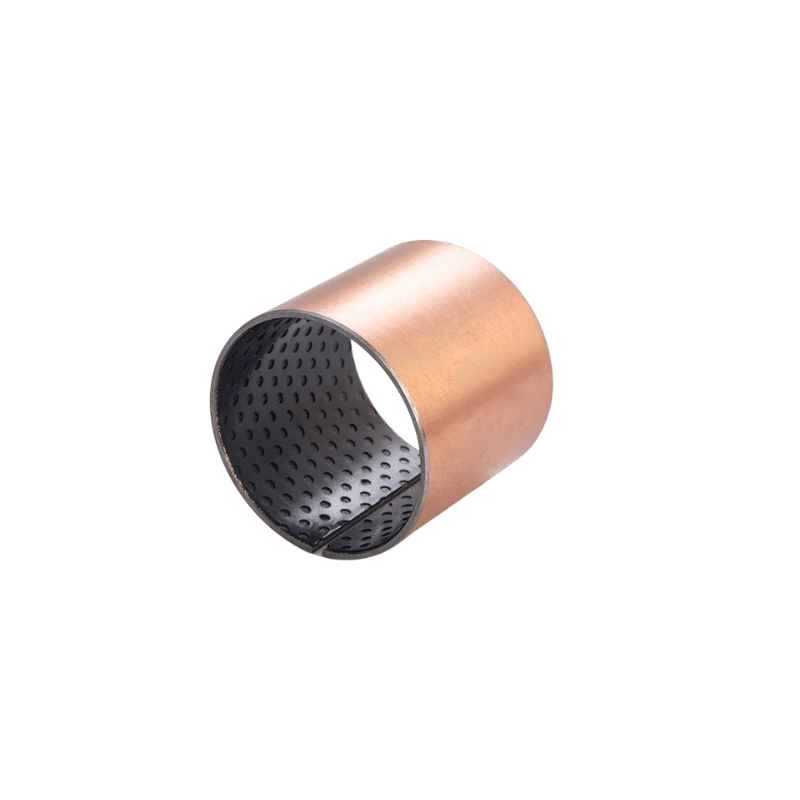
POM composite bushings
Metal-Polymer Composite Bushing Material
Steel Back + Porous Bronze Sinter +
POM with Lubrication Indents

Specializing in metal customized plain bearing solutions.
Sliding Bearing Maintenance bound sliding bearings
Whether you need the high load capacity of a solid bronze bearing with lubricant plugs, the balanced performance of a metal-polymer composite, or a specific rolled or turned bronze solution engineered for self-lubrication, understanding the underlying technologies and characteristics is key. Moving beyond superficial knowledge allows engineers and designers to select the optimal solution, unlocking greater efficiency and longevity in their machinery.

Maintenance-Free Sliding Bearings Type
The choice between self-lubricating and maintenance-bound sliding bearings is a fundamental engineering decision with significant long-term implications. While traditional, maintenance-bound bearings have their place, especially where lubrication is easily managed and potentially offers performance benefits in specific high-demand scenarios, the trend strongly favors self-lubricating solutions.




Self-Lubricating vs. Maintenance-Bound Sliding Bearings: Choosing the Right Path for Your Application
Viiplus provides our global industrial, defense customers with unique design solutions. maintenance-free sliding bearings, self-lubricating bearings, plain bushing, bronze bushing, steel-backed bronze bushing, solid lubricant bearing, multi-layer bearings, rolled bronze, turned bronze, bearing selection are designed to meet industry standards for self-lubricating bushings.
Custom Plain Bearing, Ready for what’s next
Collaborating closely with our customers yields more than customized solutions. By deeply understanding various challenges, we can research new materials and component designs. Ongoing testing allows us to evaluate the performance of our tailor-made bearings. This enables us to analyze factors affecting performance, including environmental changes, different forces and friction, various materials and surfaces, and the use of lubricants.
Browse our Services for Custom Self-lubricating Bearings
Browse our Services for Custom Self-lubricating Bearings
Browse our Services for Custom Self-lubricating Bearings
Browse our Services for Custom Self-lubricating Bearings
Browse our Services for Custom Self-lubricating Bearings
