
Unlocking Smooth Motion: A Deep Dive into Plain Bushes for Bearing Applications
In the vast world of mechanical components, seemingly simple parts often play the most critical roles. The plain bush, also known as a bush bearing or sliding bush, is a prime example. These unassuming cylinders are fundamental to enabling smooth, low-friction movement in countless applications, from complex industrial machinery to everyday objects.
But what exactly is a plain bush for bearing? Why choose one over other bearing types? And how do modern materials, especially polymer composites, revolutionize their performance? Let’s dive deep into the world of plain bushes.

Get Instant Quote
To get your instant quote, just send your drawings file and select your production process and material.
Place Order
After placing your order, production will start. You’ll receive regular status updates.
Receive Parts
We provide quality assurance, quality reports, and delivery tracking.
Our complete product range, Plain bushings bronze, maintenance-free, Customized plain bearings to deliver optimal performance
Our slide bearings at a glance.
What is a Plain Bush (Bush Bearing)?
At its core, a plain bush is a type of bearing designed to provide a low-friction sliding surface between two components, typically a shaft and a housing. Unlike rolling element bearings (like ball or roller bearings) which use rolling elements to separate moving parts, plain bushes rely on a sliding action.
Plain Bearings vs. Rolling Element Bearings: A Quick Contrast
| Feature | Plain Bush (Sliding Bush) | Rolling Element Bearing (e.g., Ball Bearing) |
| Mechanism | Sliding Contact | Rolling Contact |
| Friction | Generally higher starting friction | Generally lower starting friction |
| Complexity | Simple, often one-piece construction | More complex, multiple components |
| Load Capacity | Excellent static load capacity, good dynamic | Good dynamic load capacity |
| Speed | Typically suited for lower to moderate speeds | Can handle higher speeds |
| Noise | Very quiet operation | Can generate some noise |
| Shock Load | Often better tolerance | Can be susceptible to brinelling |
| Size | Compact radial & axial dimensions | Can be bulkier |
| Cost | Often more cost-effective | Can be more expensive |
Plain bushes excel in applications requiring:
-
Compact design
-
High static load capacity
-
Cost-effectiveness
-
Quiet operation
-
Tolerance to some misalignment (depending on type)
-
Resistance to shock loads
The Heart of the Matter: Bushing Material Evolution
The performance of a plain bush for bearing is fundamentally determined by its material. Historically, metals like bronze, brass, and steel alloys were common choices, often requiring regular lubrication (oil or grease) to maintain low friction and prevent wear.
However, significant advancements have led to the dominance of low-maintenance, polymer composite plain bearings. These materials offer exceptional performance with minimal or zero external lubrication. Let’s explore the key players:
1. Polymer Composite Bushes: The Low-Maintenance Champions
These bushes utilize engineered plastics, often reinforced with fibers and embedded with solid lubricants.
-
PTFE (Polytetrafluoroethylene) Based Bushes:
-
Sliding Material: PTFE is renowned for its incredibly low coefficient of friction – one of the lowest of any solid material.
-
Mechanism: Often works by transferring a thin film of PTFE to the mating shaft surface, creating a low-friction PTFE-on-PTFE contact. Can be incorporated as fibers woven into a fabric liner, dispersed within a polymer matrix, or as a distinct layer.
-
Pros: Excellent self-lubrication (ideal for dry running), superb chemical resistance, wide temperature range (though mechanical properties decrease at extremes).
-
Cons: Relatively lower load capacity compared to metals or some other polymers, can be susceptible to creep under sustained load.
-
Example Structure: A PTFE-fabric lined bush might have a metal or composite backing for strength, an intermediate bonding layer, and the PTFE-based sliding layer.
-
-
POM (Polyoxymethylene / Acetal) Based Bushes:
-
Sliding Material: POM is a high-strength thermoplastic known for its rigidity, low friction (though higher than PTFE), excellent wear resistance, and low moisture absorption.
-
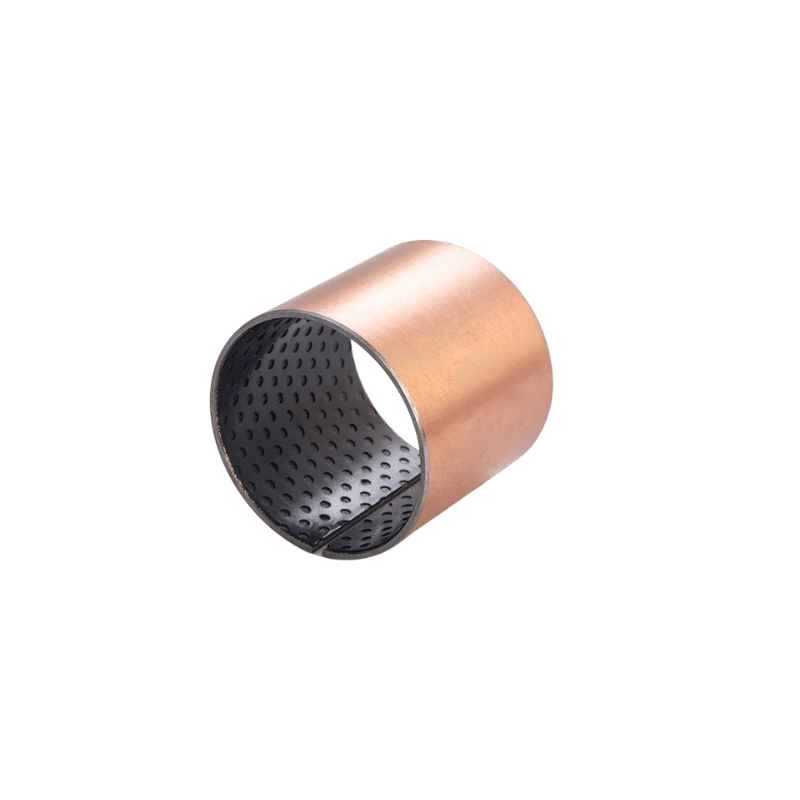
Mechanism: Relies on the inherent low-friction and wear-resistant properties of the POM material itself, often enhanced with fillers like PTFE or silicone oil. Many POM bushes feature lubrication pockets or dimples on the surface to retain initial grease or trap wear debris.
-
Pros: Good mechanical strength and rigidity, excellent dimensional stability, good wear resistance, cost-effective.
-
Cons: Lower temperature limit compared to PTFE, less chemical resistance than PTFE.
-
Ideal Use: Moderate loads, applications requiring good dimensional stability and wear resistance where dry-running isn’t the absolute priority (though many POM variants are designed for maintenance-free operation).
-
The Power of Layers: 3-Layer Bush for Bearing (Metal-Polymer)
This is a highly effective composite structure combining the best of metal and polymer properties:
-
Layer 1: Steel Backing: Provides high mechanical strength, structural integrity, and allows for press-fitting. Can also be Bronze or Stainless Steel.
-
Layer 2: Sintered Porous Bronze: This intermediate layer is sintered onto the steel backing. Its porosity serves two crucial functions:
-
It creates a strong mechanical bond between the steel backing and the polymer layer.
-
It helps dissipate heat generated during operation away from the sliding surface.
-
-
Layer 3: Polymer Sliding Layer (e.g., PTFE or POM based): This top layer, typically 0.01-0.03 mm thick, is impregnated into the pores of the bronze layer and forms the functional sliding surface. It provides the low friction and wear resistance characteristics. PTFE-based overlays are extremely common for the lowest friction.
Advantages of 3-Layer Bushes:
-
High load-carrying capacity (due to steel backing).
-
Excellent heat dissipation (due to bronze interlayer).
-
Very low friction and wear (due to polymer overlay, especially PTFE).
-
Compact dimensions.
-
Suitable for dry running or initial lubrication.
Bushing Material Comparison Chart:
| Feature | Traditional Metal (e.g., Bronze) | PTFE Composite | POM Composite | 3-Layer (Metal-Polymer) |
| Friction Coeff. | Moderate (needs lube) | Very Low | Low | Very Low (PTFE) / Low |
| Dry Running | Poor (requires lubrication) | Excellent | Good (often designed for) | Excellent (PTFE layer) |
| Load Capacity | High | Moderate | Good | Very High |
| Temperature Range | Wide (material dependent) | Wide (mech. limits) | Moderate | Wide (backing limited) |
| Maintenance | High (lubrication needed) | Very Low / None | Low / None | Very Low / None |
| Chemical Resist. | Varies | Excellent (PTFE) | Good | Good (overlay limited) |
| Cost | Moderate | Moderate to High | Low to Moderate | Moderate |
How They Work – A Quick Primer
Sliding Bearings: These rely on direct contact between two surfaces, often separated by a thin film of lubricant. They can be simple bushings or more complex hydrostatic/hydrodynamic designs.
Rolling Bearings: These use rolling elements (balls, rollers, needles) placed between an inner and outer ring. Motion is achieved by the rolling of these elements, significantly reducing friction compared to sliding contact.

Specializing in metal customized plain bearing solutions.
Plain bearings cylindrical, flanged, Manufacturing on Demand
Plain bushes accommodate rotary, oscillating, and short- or long-stroke linear motion. A “bush for plain bearing” refers to a type of bearing component that helps reduce friction between two moving parts, typically in rotary, oscillating, or linear motion applications. These bushes are commonly used in situations where low maintenance and simple design are required. The material choice for plain bearing bushes can vary, including metals, plastics, or composite materials, depending on the specific needs of the application.

Custom self-lubricating Bushing for bearing, Maintenance free sliding Bushing
Self-lubricating: Some plain bushes come with self-lubricating properties to minimize maintenance. Material Variety: They can be made of metals, plastics, or composites, and are designed to withstand varying loads and speeds
Versatility in Motion: Beyond Rotation
A key advantage of the plain bush is its versatility. While commonly associated with rotating shafts, their application extends further:
Rotary Motion: The classic application – supporting a rotating shaft within a housing (e.g., gearbox shafts, pivots).
Oscillating Motion: Ideal for back-and-forth pivoting movements (e.g., linkages, hinges, suspension components). Polymer bushes often outperform rolling bearings here as they don’t suffer from fretting corrosion or brinelling caused by small, repetitive movements.
Linear Motion: Plain bushes are highly effective for guiding linear movement, acting as sliding bush guides for rods or shafts over both short and long stroke lengths (e.g., pneumatic/hydraulic cylinder rods, guide rails, sliding mechanisms). Specific linear plain bearing designs optimize this function.




The Self-Lubricating Bearing Industry: Plain Bushes Materials, Markets, and Future Potential
The humble plain bush or bush bearing is far more sophisticated than it appears. From simple metallic sleeves to advanced, low-maintenance polymer composite and 3-layer bush for bearing designs utilizing PTFE or POM, these components are engineered for reliable, efficient motion. Their ability to handle rotary, oscillating, and linear movement, combined with the self-lubricating benefits of modern bushing material, makes them an indispensable choice for engineers and designers seeking robust, cost-effective, and high-performance sliding solutions. When you need smooth, reliable movement, don’t overlook the power of the plain bush for bearing.
Custom Plain Bearing, Products Rolling and Plain Bearings,Plain Bearings and Bushing
Plain bushes are critical components in a range of mechanical systems, offering a cost-effective and efficient way to manage friction and wear.
Browse our Services for Custom Self-lubricating Bearings
Browse our Services for Custom Self-lubricating Bearings
Browse our Services for Custom Self-lubricating Bearings
Browse our Services for Custom Self-lubricating Bearings
Browse our Services for Custom Self-lubricating Bearings
