
The Marvel of Maintenance-Free Slide Plates: Solid Lubricant Bronze Wear Plates
In the world of industrial machinery, friction is a nemesis that leads to wear and tear, resulting in regular maintenance needs and shortened equipment life. However, thanks to companies like VIIPLUS, we now have solutions that focus on minimizing friction, and consequently, wear and lubrication demands. Guide Slide Plate: Bronze Graphite, Self-Lubricating. Maintenance-Free Operation: These plates do not require additional lubrication, which simplifies maintenance and reduces operational costs

Bronze Bearing
Metal Products
Continuous Cast Bronze Alloys

Continuous cast bronze Alloys used across various industries—fluid power, oil and gas, machine tools, and more!

Providing the right material at the right time—helping our customers save both time and money.
Discover the Oilless Wear Plate – Graphite Filled Bronze, Sliding Plate, Graphite–bronze sliding plate with base plate
specializing in Slide plate, Sliding Plate Bronze Graphite, Oil-Free Slide Plates – 10 mm Thick, Copper Alloy with Graphite
VIIPLUS offers a unique range of maintenance-free slide plates that are designed with solid lubricant plugs embedded into a strong cast bronze base. Two types of these plugs are available, catering to different application needs. The bronze wear plates provide a low friction coefficient, which extends the machine’s lifespan by reducing wear and tear. Moreover, these plates come without pre-drilled holes, offering flexibility in mounting patterns.
The base material for these wear plates is a blend of bronze and Molybdenum disulphide (MoS2) with Graphite, resulting in a robust and high-performance material that guarantees optimal operation even under shock loads. This combination of materials also makes the wear plates highly resistant to corrosion and wear, ensuring longevity.
The slide plates are available in different design types, including straight bushings, flanged bushings, slide plates, and thrust washers. With VIIPLUS’s custom-made slide plates, customers from a range of industries can choose the right plate for their specific application.

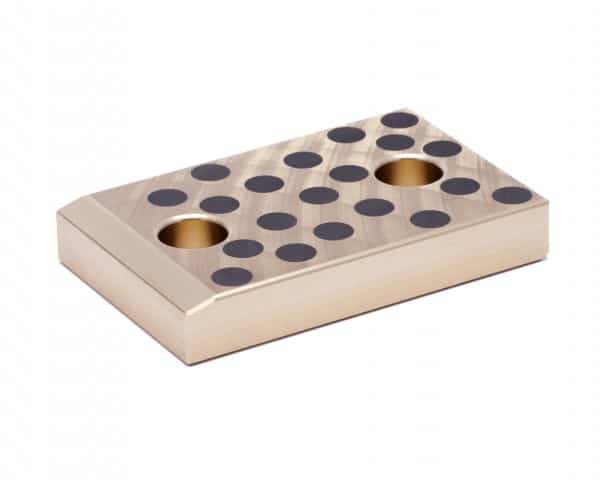


What is a Brass Slide Plate? Sliding Plate Bronze Graphite
In essence, a slide plate is a type of linear bearing that can be part of several structural and mechanical systems, such as the expansion joints of bridges, high-temperature horizontal ducts of water-tube boilers, and more. It functions as an interface between two parts, one plate being fixed while the other glides atop it as expansion or contraction happens.
The primary purpose of the slide plate is to facilitate this movement while minimizing friction and wear. As such, its role becomes incredibly critical in ensuring the longevity of the components it serves.
- CuSn12Ni2: Known for its excellent mechanical properties and corrosion resistance.
- CuZn25Al5Mn4Fe3: Provides high strength and good wear resistance.
- CuAl10Fe5Ni5: Offers superior toughness and excellent resistance to impact and fatigue.
Standard metric size brass Wear Plate & Custom Size (Inch), graphite embedded wear bushings and Brass slide plates

Sliding Plate Bronze Graphite Custom Size Manufacturing:
VIIPLUS offers its high-performance plain bearings in various materials, including CuZn25Al5 for the support material, with a sliding layer solid lubricant surface of approximately 25-30%. Other commonly used bronze alloys include CuAl10Ni, CuSn12Pb, and CuSn7ZnPb. These materials ensure durability and longevity, even under demanding conditions.
Manufacturing slide plates in custom sizes involves precisely shaping the plates to fit the dimensions specified by the customer. This is achieved through various processes such as casting, machining, or forging, depending on the size and complexity of the plate.
These processes need to be carried out with high precision to ensure the slide plate fits seamlessly into the application and performs as expected. A slide plate that is too large or too small may not function properly, recognized to increased friction, wear, and potential system failure.

Sliding Plate Bronze Graphite, Groove Pattern Slide plate:
For higher requirements such as higher temperature ranges, VIIPLUS offers a range of different slide plate materials. To accommodate larger diameters or to modify the conditions of slide plate application, customers are encouraged to reach out to VIIPLUS.
The groove pattern in bronze wear slide plates is typically designed to accommodate solid lubricants such as graphite. This is crucial for the maintenance-free operation of these plates. By creating a specific pattern of grooves on the sliding surface of the plate, the lubricant is evenly distributed across the plate, ensuring smooth operation and minimal friction. The design of the groove pattern can vary depending on the specific requirements of the application. Some common patterns include circular, diamond, and linear grooves, among others. For excellent results, the groove pattern should be designed with the direction of movement and load distribution in mind. This ensures the lubricant is distributed in the most effective manner to reduce friction and wear.

Bronze Graphite: Custom manufacturing
If you want to explore more about VIIPLUS’s slide plate and its array of maintenance-free material, oilless slide bushing & wear plate products, get in touch today. Don’t forget to plan and schedule your purchasing order in advance to ensure timely shipment. Contact us and learn more about our innovative sliding plate and guide bushing technologies.
Let VIIPLUS lead your way to a maintenance-free, cost-efficient future.
Custom manufacturing of bronze wear slide plates requires careful planning and design to ensure they meet the specific requirements of each application. It’s always recommended to work with experienced manufacturers who can provide expert guidance and high-quality manufacturing processes to produce customized slide plates that perform optimally in their intended application.
Custom-Sized Graphite-Bronze Sliding Plate with Base Plate
VIIPLUS’s slide plates find applications in numerous industries and machinery types, such as cranes, mining machines, construction machinery, offshore & marine applications, steel plants, and hydro power & hydro mechanical equipment.
In the vast world of structural and mechanical engineering, an often-understated component plays an invaluable role in ensuring smooth, efficient, and effective operation of various mechanical systems – the Slide Plate. Specifically, the bronze wear slide plate is a mechanical marvel, crucial in dealing with expansion or contraction that occurs in various engineering applications.
Exploring the benefits of bronze wear slide plates in structural engineering: graphite-bronze sliding plate with base plate.
Graphite embedded wear bushings and plates are effective solutions for enhancing the performance and longevity of machinery in demanding environments. Their unique properties make them indispensable in various industrial applications where traditional lubrication is not feasible. Bronze Wear Sliding Plate Material manufacturing, graphite embedded wear bushings and plates, Applications Of Bronze Wear Sliding Plates and feature
Slide Plates,evaluate viiplus on bronze slide plate
VIIPLUS is a Chinese manufacturer specializing in self-lubricating bearings and components, with their bronze slide plates (also called wear plates or sliding plates) being a flagship product designed for high-load, low-speed applications where maintenance-free operation is critical.
These plates are typically made from high-strength bronze alloys embedded with solid graphite plugs (or sometimes MoS2), creating an oil-free, self-lubricating surface that transfers a thin lubricant film during operation to minimize friction and wear
Function Slide Plate in Plastic Mold Components: Bronze Graphite Plugged Solutions
In plastic mold components (Plastic Mold Components), the Function Slide Plate is a standard or configurable part commonly used to guide linear motion. Typically, it refers to bronze slide plates with embedded graphite plugs (Bronze Graphite Plugged Slide Plates). These plates are essential for ensuring smooth, precise movement in molds, providing self-lubrication and durability for high-performance applications.
What is a Function Slide Plate?
A Function Slide Plate is made from high-strength bronze alloys, such as C83600 or C95400, with solid graphite inserts embedded in 25%-35% of the sliding surface. This design allows for oil-free lubrication, reduced friction, and excellent wear resistance.
These plates are suitable for high-load, low-speed linear sliding applications and comply with international standards like ASTM B22. They can also be customized to specific mold dimensions (metric/imperial), thicknesses (e.g., 10mm, 20mm), and mounting hole positions.
In plastic molds, Function Slide Plates primarily guide the linear motion of mold cores or slides, ensuring smooth injection processes and precise molding. They are ideal for high-durability, low-maintenance applications in injection molding machines, die-casting molds, and stamping equipment.
Typical Applications of Function Slide Plates
Here are the common locations and specifications for Function Slide Plates in plastic mold assemblies:
| Application | Description | Key Specifications & Benefits |
|---|---|---|
| Mold Slides | Mounted on mold sides or cores to control lateral opening and closing movements, e.g., automotive parts or container molds. | Thickness 10-20mm; graphite inserts provide self-lubrication, reducing friction 25%-35%; improves mold accuracy and lifespan. |
| Guide Rails & Gibs | L-shaped or T-shaped guides (L-Gibs/T-Slides) fixed to the mold frame to guide linear sliding paths. | Solid bronze alloy with embedded graphite; high-temperature resistance (>500°C); prevents sticking in heavy-duty molds and improves operational efficiency. |
| Cam Bottom Guide Plates | Located at the bottom of cam mechanisms to support rotational-to-linear motion, e.g., complex geometry plastic parts. | Oil-free design; high load capacity; reduces maintenance costs. |
| Wear Pads & Support Plates | Placed under mold legs or support structures to absorb thermal expansion and vibration. | Aluminum bronze (C95400), corrosion-resistant; suitable for high-temperature mold support systems. |
| Injection Mold Core Guides | Embedded in mold cores to guide sliding components during plastic injection. | Custom graphite patterns; low friction coefficient (<0.2); ensures micron-level accuracy for automotive and electronic plastic molds. |
Selection and Installation Guidelines
-
Material Selection
-
Prefer high tensile brass or aluminum bronze.
-
Graphite insert patterns can be customized (cylindrical or rectangular slots) based on load and friction requirements.
-
-
Specification Customization
-
Width, length, and thickness can be tailored according to mold design and standards (e.g., NAAMS).
-
Low minimum order quantities; CAD-supported design available.
-
-
Installation
-
Bolt-mounted or welded to steel backing plates.
-
Regularly check for wear and ensure torque meets manufacturer specifications (e.g., 1/4-inch welds).
-
-
Advantages
-
Self-lubricating, reducing downtime and maintenance costs.
-
Resistant to high loads and extreme temperatures (air: +1000°F, inert: +3000°F).
-
Suitable for injection molding, die-casting, and stamping molds; improves precision and mold longevity.
-
Conclusion
The Function Slide Plate is an essential self-lubricating component in plastic mold assemblies. Its combination of bronze alloy strength and embedded graphite ensures oil-free, low-friction, wear-resistant performance. From mold slides and guide rails to cam bottom plates and injection mold core guides, the right Function Slide Plate extends mold life, reduces maintenance costs, and guarantees precise molding operations.
For mold designers and manufacturers, selecting and installing the correct Function Slide Plate is critical for high-efficiency, long-term stable production.
Bronze slide plates are engineered to deliver reliable performance in demanding applications where high loads and low speeds are common. Designed to eliminate the need for oil or grease, they provide an ideal solution in environments where conventional lubrication is impractical or undesirable.
Our guide slide plates are manufactured from special brass (SO#50SP2) and embedded with solid graphite lubricants, giving them excellent self-lubricating properties. This unique combination ensures smooth operation, minimal maintenance, and superior durability under extreme working conditions.
Key Features
-
Material: High-quality bronze with solid graphite lubricants
-
Self-Lubricating: Provides smooth sliding motion without external grease or oil
-
High-Performance Alloy: Special brass (SO#50SP2) for enhanced strength and reliability
-
Temperature Resistance: Withstands up to 1100°F (593°C) in graphite-impregnated form
-
Load Capacity: Suitable for high-pressure systems up to 5,000 PSI
Technical Benefits
Bronze wear slide plates are valued for their exceptional wear resistance, low friction, and ability to perform reliably under heavy loads and high temperatures. The base bronze alloy—typically a copper-tin composition, often modified with elements such as aluminum, manganese, nickel, or zinc—offers outstanding mechanical strength and corrosion resistance.
The sliding surface is embedded with solid lubricants like graphite or molybdenum disulfide (MoS₂), strategically dispersed to reduce friction and extend service life. This design ensures consistent lubrication that does not deteriorate with wear, even in extreme operating conditions.
Applications
-
Expansion joints in bridges
-
Boiler and furnace ducts
-
High-temperature ducts and mechanical systems
-
Heavy-duty structural and industrial equipment
Advantages
-
Maintenance-free operation
-
Built-in self-lubrication
-
Excellent wear resistance
-
Extended service life
-
Consistent lubrication performance, unaffected by wear
-
Prevents dust and debris buildup
-
Greater durability than conventional graphite solutions
-
Withstands extreme pressures and high temperatures
Graphite Slide Plates: Key Applications in the Oil & Gas Industry
Graphite Slide Plates are self-lubricating, high-temperature, and corrosion-resistant bearing components, typically made from a bronze base embedded with graphite particles. In the oil & gas industry, they are widely used in applications that demand low friction, maintenance-free operation, and high load capacity, especially in high-temperature (up to 1100°F / 593°C) and high-pressure environments. They effectively reduce stress caused by thermal expansion in pipelines and equipment.
Based on industry data, the most common applications of graphite slide plates in oil & gas are in piping systems, storage facilities, and equipment supports. Here’s a detailed overview:
Applications of Bronze Wear Slide Plates
Bronze wear slide plates play a critical role in enabling smooth movement and reducing wear in various mechanical and structural systems. Their ability to accommodate heavy loads, thermal expansion, and mechanical stress makes them indispensable in demanding environments.
1. Piping Systems
Application: Pipe supports, sliding brackets, and conduit connections in oil & gas pipelines and refineries.
Advantages:
-
Ensures smooth movement during pipe thermal expansion and contraction
-
Low friction and maintenance-free operation
-
High-pressure tolerance up to 5000 PSI
-
Suitable for heavy-duty oil and gas transport systems
2. Storage Tanks
Application: Sliding support plates for tank bottoms and sidewalls in crude oil or LNG storage facilities.
Advantages:
-
Self-lubricating design prevents sticking
-
Corrosion-resistant, extending service life
-
Accommodates temperature-induced expansion and contraction
-
Ideal for oilfield and LNG storage applications
3. Offshore Drilling Platforms
Application: Sliding surfaces for drilling equipment, risers, and platform supports.
Advantages:
-
Maintenance-free operation in harsh marine environments
-
Handles heavy loads at low speeds
-
Resistant to seawater corrosion and extreme conditions
4. Refinery Equipment
Application: Sliding bearings or wear plates in heat exchangers, compressors, and turbines.
Advantages:
-
High-temperature tolerance (>200°F)
-
Reduces friction and wear on moving parts
-
Suitable for petrochemical processing equipment
5. Dust Collectors and Pressure Vessels
Application: Support and sliding surfaces in industrial dust collection systems and high-pressure vessels.
Advantages:
-
Prevents dust accumulation
-
Self-lubricating, extending service life
-
Resistant to corrosive media, ideal for natural gas processing plants
Material Considerations
For oil & gas applications, graphite slide plates are typically made from manganese bronze alloys such as C83600 or C86300, chosen based on load, temperature, and corrosion requirements. In many high-temperature cases, graphite slide plates can replace PTFE plates for improved performance.
Summary: Graphite slide plates provide reliable, maintenance-free performance in heavy-load, low-speed, high-temperature, and corrosive environments, making them essential for pipelines, storage tanks, offshore rigs, and refinery equipment in the oil & gas sector.
Suppliers can provide custom alloy selection, CAD files, and specific product solutions for unique applications.
Key Applications
1. Bridges
-
Expansion Joints: Bronze wear slide plates absorb movements caused by temperature fluctuations, wind forces, and traffic loads. They reduce friction, prevent structural damage, and extend the service life of bridges.
-
Types: Highway bridges, overpasses, railroad bridges.
2. High-Temperature Ducts and Industrial Systems
-
Water-Tube Boiler Ducts: Slide plates allow for thermal expansion in high-temperature horizontal ducts, minimizing stress and ensuring long-term reliability.
-
Industrial Equipment: Heat exchangers, dust collectors, heavy machinery, refinery equipment, wind tunnels, penstocks, vessels, pipelines, air preheaters, and atomic energy applications.
3. Architectural and Structural Engineering Applications
-
Buildings and Structures: Cross beams, girder slip joints, roof slabs, corbels, vibration pads, airport hangar doors, domes, and transmission towers.
-
Materials: Suitable for wood, concrete, or steel construction, providing smooth movement and protection against wear.
4. Offshore and Specialized Applications
-
Storage tanks, offshore drilling rigs, and other high-stress industrial environments benefit from the durability and self-lubricating properties of bronze wear slide plates.
Despite their simplicity, bronze wear slide plates are unsung heroes in engineering, silently enhancing the reliability, longevity, and safety of infrastructure and mechanical systems. From bridges to boilers, industrial machinery, and architectural structures, these components ensure smooth operation and minimize maintenance.
| Bronze Alloy Code | Main Composition | Features | Typical Applications | Hardness | Tensile Strength |
|---|---|---|---|---|---|
| C95400 | Cu: 83%, Al: 11%, Fe: 4% | High strength, excellent wear resistance, good corrosion resistance | Bearings, Gears, Heavy-duty machinery | 170-210 HB | 70-105 ksi |
| CuAl10Ni5Fe4 | Cu: 79%, Al: 10%, Ni: 5%, Fe: 4% | Good wear and corrosion resistance, high load capacity | Marine engineering, Bearing bushes, Pump parts | 170-210 HB | 70-90 ksi |
Please note that the actual properties of these alloys may vary depending on the specific manufacturing process and heat treatment. Also, the composition percentages mentioned above are approximations and may differ slightly based on the exact alloy formulation. It’s always excellent to consult with a materials engineer or the supplier for exact specifications.
The CuAl10Ni5Fe4 alloy, often referred to as Aluminium Bronze, is a popular material for slide plates due to its excellent wear resistance, strength, and corrosion resistance. The alloy can withstand high loads, making it a suitable choice for demanding applications.
In terms of equivalent materials, the exact match will depend on the specific properties needed for the application. However, here are a few commonly used materials that can provide similar properties:
- C95400 (Aluminum Bronze): This is the most common Aluminum Bronze alloy and it’s often used in high-load, high-wear applications. While the composition isn’t an exact match to CuAl10Ni5Fe4, the properties it exhibits are similar, providing high strength and excellent wear and corrosion resistance.
- C63000 (Nickel Aluminum Bronze): This alloy has a similar composition to CuAl10Ni5Fe4 with additional Nickel content, providing increased strength and improved corrosion resistance, particularly in marine applications.
- C63200 (Nickel Aluminum Bronze): Similar to C63000, this alloy offers excellent strength, toughness, and wear resistance, with the added advantage of being heat treatable to further enhance these properties.
Remember, while these alloys provide similar properties, the excellent choice of material will depend on the specific requirements of your application, including load, speed, temperature, and environmental conditions. It’s always recommended to consult with a material specialist or the manufacturer for specific advice.
CuZn40Al2, often referred to as Aluminium Brass, is an alloy that includes copper (Cu), zinc (Zn), and aluminium (Al). It is known for its superior strength, good wear resistance, excellent corrosion resistance, and improved machinability. Here’s a quick breakdown of some of its key features:
- Strength & Hardness: CuZn40Al2 exhibits a good balance of strength and hardness. Its mechanical properties make it suitable for applications that require durability and resistance to wear.
- Corrosion Resistance: With the presence of aluminium, this alloy exhibits excellent resistance to corrosion, particularly in marine environments and other settings where resistance to corrosive elements is crucial.
- Wear Resistance: The alloy demonstrates high wear resistance, making it suitable for applications where components are subject to friction, like slide plates.
- Thermal Conductivity: CuZn40Al2 alloy has excellent thermal conductivity. This property, combined with its resistance to wear and corrosion, makes it useful in high-temperature applications.
- Machinability: Compared to other high-strength brass alloys, CuZn40Al2 has improved machinability. This property makes it easier to process and form into various shapes and forms, including slide plates.
These features of CuZn40Al2 make it suitable for a variety of applications, particularly in slide plates that are used in demanding environments, where resistance to wear, strength, and durability are required. As always, the exact performance of the alloy will depend on the specific conditions of use, and professional advice should be sought for critical applications.
Bronze-plated wear plates offer a robust solution for applications requiring friction-reducing surfaces, such as slides, cams, or flat areas in molding processes. These wear plates are engineered with superior quality bronze material, providing outstanding durability and strength.
The bronze plating on these wear plates delivers a high degree of wear resistance, making them ideal for high-load, high-wear environments. The surface of the plate is designed to withstand repetitive motion and constant friction, significantly reducing the wear and tear that often comes with these conditions.
In addition to their impressive wear resistance, bronze-plated wear plates also offer excellent anti-friction characteristics. This is crucial in applications involving slides or cams, where a smooth and seamless movement is essential. The bronze plating provides a smooth surface that significantly reduces friction, allowing for more efficient movement and operation.
Moreover, these wear plates are often embedded with solid lubricants, such as graphite. This unique feature further enhances their anti-friction characteristics and contributes to their maintenance-free operation. The lubricant is strategically distributed across the wear plate to provide consistent lubrication, reducing the need for manual lubrication and the associated maintenance costs.
Furthermore, bronze-plated wear plates can be custom designed and manufactured to fit specific applications. This includes customization of the size, thickness, groove patterns, and lubricant embedding, ensuring the wear plate fits perfectly into the mold or machinery, and functions optimally.
In conclusion, bronze-plated wear plates offer an efficient and durable solution for applications requiring long-lasting wear surfaces. Their superior wear resistance, excellent anti-friction properties, and customizable features make them an ideal choice for various industrial applications. As always, it is advisable to consult with a wear plate specialist to determine the excellent solution for your specific needs.
A slide plate in the context of pipe fittings is generally used to facilitate the movement of the pipe system due to thermal expansion, contraction, or other dynamic forces. Slide plates are designed to reduce the friction between the pipe and the supporting structure, allowing the pipe to move smoothly over the surface. These are especially important in industrial settings where pipes can be exposed to a wide range of temperatures and pressures.
Here are some key characteristics of slide plates used in pipe fittings:
Material
- PTFE (Polytetrafluoroethylene): Commonly used because of its low friction properties.
- Stainless Steel: Used for its durability and resistance to corrosion.
- Bronze: Sometimes used for its self-lubricating properties.
Types
- Graphite Slide Plates: These have a layer of graphite to reduce friction further.
- Ball Bearing Slide Plates: These incorporate ball bearings to allow for extremely smooth movement.
- Elastomeric Slide Plates: These use a layer of rubber or other elastomers to absorb shock and vibration.
Installation
Slide plates are usually installed between the pipe shoe and the supporting structure. They may be welded, bolted, or clamped into place, depending on the specific requirements of the application.
Applications
- Petrochemical Plants: For pipes carrying hot fluids.
- Power Plants: For steam pipes that expand and contract.
- HVAC Systems: For accommodating thermal expansion in long pipe runs.
- Water Treatment Plants: For pipes that may need to move due to ground shifting or other dynamic forces.
Maintenance
Regular inspection is required to ensure that the slide plates are in good condition and providing the necessary reduction in friction.
Would you like to know more details about any specific type of slide plate or its application?
Graphite-embedded wear bushings and plates, graphite-bronze sliding plates
graphite embedded wear bushings and plates for. plastic mold injection, Graphite embedded wear bushings and plates are specialized components designed to enhance performance in various industrial applications through self-lubrication and improved wear resistance.


Projects
Make your space useful and different
Experience of over 10 years of successful projects on creating unique and modern interior designs all over the world.

Learn More
