
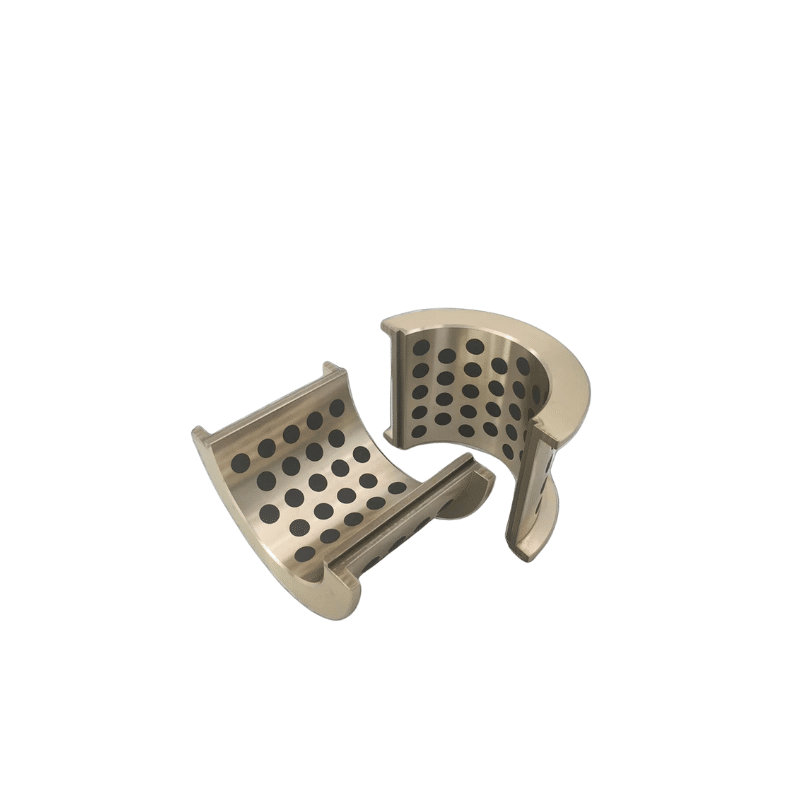
JZW Split Self-Lubricating Flanged Bearings
Unlocking Performance in Tight Spaces: A Deep Dive into JZW Split Self-Lubricating Flanged Bearings
In the demanding world of industrial machinery, bearing selection is critical. Standard solutions often fall short when faced with challenging installation constraints, high temperatures, heavy loads, or environments where regular lubrication is impractical. Enter the JZW series of Split Self-Lubricating Flanged Bearings – a specialized solution engineered to overcome these very hurdles.
JZW Split Bushing Bearings, Half bearing bronze graphite bushes, Double Flange Split Bronze Bushing Custom Made Bearing Bush Bronze Bushing Oilless Bearing
What Makes JZW Split Bearings Unique? The “Split” and “Flanged” Advantage
The core identity of these JZW bearings lies in their split design. Unlike standard solid bushings that require axial access for installation, these bearings are meticulously machined into two precise semicircles
Why the Split? Installation Necessity.
Imagine a shaft already fixed between two structures, or a housing design where the ends are inaccessible. This is where the split design becomes indispensable. The two halves can be assembled around the shaft and within the housing bore, eliminating the need for axial insertion. This is particularly crucial for types featuring:
-
Double Flanges (两端带有双法兰): Flanges on both ends provide robust bi-directional axial location but make end-on installation impossible.
-
Side Flange (边法兰式): A single flange for axial positioning on one side.
-
Middle Flange (中法兰式): A central flange, often for specific location or sealing purposes within the housing.
-
Straight Sleeve Type (直套式): Even non-flanged versions can be split for installation convenience in specific assemblies.
While the split design solves installation challenges, it means the dimensions after splitting are technically non-standard. However, the length and specific features are highly customizable to meet user requirements.
The Science Inside: Material Composition and Self-Lubrication
The performance of JZW bearings stems from a sophisticated combination of base material and embedded lubrication technology.
1. The Base Material: High-Strength Brass (ZCuZn25AI6Fe3Mn4)
The foundation is typically a robust high-strength brass alloy, specifically ZCuZn25AI6Fe3Mn4 (高力黄铜 – gāolì huángtóng). This isn’t just any brass; its composition is tailored for demanding applications:
Table 1: Chemical Composition of ZCuZn25AI6Fe3Mn4 High-Strength Brass
| Element | Symbol | Percentage (%) | Role & Benefit |
| Copper | Cu | 60 – 66% | Primary base metal, good thermal conductivity |
| Aluminum | Al | 5.0 – 7.5% | Significantly increases strength and wear resistance |
| Manganese | Mn | 2.5 – 5.0% | Improves strength, toughness, and corrosion resistance |
| Iron | Fe | 2.0 – 4.0% | Enhances strength and hardness |
| Zinc | Zn | 22 – 28% | Primary alloying element for brass properties |
| Nickel (max) | Ni | 0.2 – 0.5% | Further improves corrosion resistance (often minor) |
This specific alloy provides an excellent balance of:
-
High Load Capacity: The aluminum, manganese, and iron content create a strong, rigid structure capable of supporting heavy radial and axial loads.
-
Wear Resistance: Essential for longevity, especially under boundary lubrication conditions.
-
Machinability: Allows for precise manufacturing of the bearing shape, lubricant pockets, and the critical splitting process.
-
Corrosion Resistance: Suitable for various industrial environments.
2. The Lubrication Mechanism: Embedded Solid Lubricants (Graphite Focus)
Embedded within precisely machined pockets or grooves on the bearing’s inner surface are solid lubricants (固体润滑剂 – gùtǐ rùnhuá jì). While various formulations exist, graphite is a prevalent and highly effective choice for many JZW bearings (石墨型 – shímò xíng).
-
How it Works: Graphite possesses a layered crystal structure. During operation, microscopic layers shear off easily under friction and pressure. This material transfers to both the bearing surface and the mating shaft, creating a low-friction solid lubricating film.
-
Key Benefits of Graphite:
-
High Temperature Resistance: Graphite maintains its lubricating properties at temperatures exceeding 450°C, far beyond the limits of conventional oils and greases.
-
Low Friction: Reduces startup torque and running friction, especially beneficial in low-speed, high-load, or intermittent motion scenarios.
-
Chemical Stability: Resists many chemicals and contaminants.
-
This embedded system means the bearing lubricates itself continuously as it operates, eliminating the need for external grease or oil supply in most recommended operating conditions.
Contrasting Logic: JZW Split Self-Lubricating vs. Traditional Greased Bearings
To truly appreciate the value of JZW split bearings, let’s contrast them with traditional plain bearings requiring manual greasing or oil lubrication:
Table 2: JZW Split Self-Lubricating vs. Traditional Greased Plain Bearings
| Feature | JZW Split Self-Lubricating Bearing | Traditional Greased Plain Bearing | Key Advantage of JZW |
| Lubrication Method | Embedded Solid Lubricant (e.g., Graphite) | External Grease/Oil Required | Maintenance-Free Operation |
| Maintenance Needs | Minimal to None (within design limits) | Regular Re-greasing Schedule | Reduced Downtime & Labor Costs |
| Temperature Range | Very High (Graphite > 450°C) | Limited by Grease/Oil Properties (Typically < 150°C) | Suitable for Extreme Heat |
| Contamination Risk | Low (No liquid lubricant to attract/trap dirt) | High (Grease can attract dirt, get contaminated) | Reliable in Dirty/Dusty Environments |
| Installation | Split design allows assembly in constrained locations | Typically requires axial access (solid ring) | Solves Difficult Installation Challenges |
| Axial Location | Flanges provide precise, built-in bi-directional control | Often requires separate thrust washers/collars | Integrated Axial Control |
| Load Capacity | High (due to robust base material) | Varies greatly by material & design | Excellent Strength for Heavy Loads |
| Environmental Impact | Cleaner (no lubricant leakage/disposal) | Potential for lubricant leakage & contamination | More Environmentally Friendly |
| Initial Cost | Generally Higher | Generally Lower | Lower Total Cost of Ownership (TCO) due to savings |
Core Advantages Summarized:
-
Maintenance-Free: Eliminates the need for lubrication schedules, reducing labor costs and downtime. Ideal for inaccessible locations.
-
High Temperature Capability: Operates reliably where oils and greases would degrade or burn off.
-
High Load Capacity: The strong bronze alloy base handles significant radial and static loads.
-
Excellent Contamination Resistance: Performs well in dusty, dirty, or moist environments without lubricant contamination issues.
-
Axial Movement Control: Integrated flanges precisely limit shaft movement in both directions.
-
Long Service Life: Combination of wear-resistant materials and continuous self-lubrication leads to extended operational life under proper conditions.
-
Installation Flexibility: The split design is a problem-solver for difficult assembly scenarios.
Typical Application Areas: Where JZW Bearings Excel
The unique characteristics of JZW split self-lubricating bearings make them ideal for:
-
Metallurgical Equipment: Continuous casters, rolling mill guides, furnace doors, ladle turrets (high temp, heavy loads, difficult access).
-
Mining Machinery: Crushers, vibrating screens, conveyors (heavy loads, dusty environments, intermittent motion).
-
Construction Equipment: Excavator joints, crane pivots (heavy loads, outdoor exposure).
-
Hydro Power & Offshore: Wicket gates, valve bushings (water presence, difficult maintenance).
-
Food & Packaging Machinery: Where lubricant contamination must be avoided.
-
High-Temperature Industrial Ovens & Furnaces: Dryer belts, heat treatment lines.
Critical Considerations for Selection and Installation
Choosing the right JZW bearing and ensuring proper installation is vital for optimal performance and longevity:
-
Load and Speed: While excellent for high loads, graphite-lubricated bearings are generally best suited for low-to-medium speeds. Very high speeds can generate excessive heat; consult manufacturer data for specific PV (Pressure-Velocity) limits.
-
Mating Shaft: The shaft running against the bearing should ideally have a surface hardness of ≥ HRC45 and a smooth finish (Ra ≤ 0.8 μm). A rough or soft shaft will accelerate wear.
-
Operating Environment: Avoid environments with strong acids or oxidizing agents that could attack the graphite or base metal unless specific corrosion-resistant variants are chosen.
-
Clearance and Fit: Ensure correct running clearance and a proper interference fit between the bearing halves and the housing bore. A loose fit can lead to hammering or improper load distribution, potentially damaging the graphite layer. Proper alignment is crucial.
-
Initial Run-In: A brief run-in period under moderate load helps establish a stable lubricating film on the mating surfaces, especially after prolonged standstill.
Need a Custom Solution?
The JZW bearing concept is versatile. Manufacturers can often provide:
-
Custom Dimensions: Tailored lengths, diameters, and flange configurations.
-
Alternative Materials: Different bronze alloys, cast iron bases, or specialized solid lubricants (e.g., PTFE-based for lower friction, MoS₂ for specific conditions) can be used.
-
Special Features: Grooves for debris removal, seals, etc.
Conclusion
JZW Split Self-Lubricating Flanged Bearings represent a powerful solution for challenging engineering applications. Their unique split design overcomes installation barriers, while the combination of high-strength bronze and embedded solid lubricants delivers maintenance-free operation, high-temperature resistance, and robust load-carrying capacity. By understanding their structure, advantages, and proper application criteria, engineers can leverage these advanced components to enhance machinery reliability and reduce total cost of ownership, especially in environments where conventional bearings struggle.
Looking for specific JZW bearing dimensions, material options, or technical advice for your application? Technical consultation and product inquiries are welcome – feel free to reach out!
split bronze, Bearing Bronze Bushings, Flanged Bushings, Custom Bronze Parts, ZCuZn25AI6Fe3Mn4
Unit: mm
| d | L | d1 | d2 | L1 | L2 | r |
| 20 | 28 | 28 | 35 | 20 | 4 | 1 |
| 25 | 33 | 33 | 40 | 25 | ||
| 30 | 40 | 38 | 48 | 30 | 5 | 2 |
| 40 | 50 | 50 | 60 | 40 | ||
| 50 | 60 | 62 | 68 | 50 |


