

Cast Bronze Bushings with Solid Lubricant Inserts, steel+graphite
Unpacking Steel Graphite Bushings: Load, Speed, and Lubrication Secrets
Steel graphite bushings are workhorses in demanding industrial applications. They offer a compelling combination of strength, durability, and the crucial benefit of self-lubrication, making them ideal for environments where traditional greasing or oiling is difficult, impractical, or even undesirable. But not all steel graphite bushings are created equal. Understanding the nuances in their design and material properties is key to selecting the right one for your specific needs.Let’s delve into the technical details using the data presented in the provided specification table for Standard series bushings, illustrating how subtle differences can significantly impact performance.What is a Steel Graphite Bushing?At its core, a steel graphite bushing combines the structural integrity and load-bearing capacity of a steel shell or base material with the low friction and self-lubricating properties of graphite or other solid lubricants. This marriage allows the bushing to operate dry, reducing maintenance and preventing contamination risks associated with liquid lubricants.Going Deeper: Analyzing the steel Series DataThe table provides specifications for four different steel bushing series models: . By comparing these, we can see how variations in base material, lubricant type, and design influence performance metrics like load capacity and speed.Here’s a breakdown of the key parameters and what they tell us:
Feature
steel with graphite bushing
Base Material
S45C
GCr15
S45C
GCr15
The foundation of the bushing’s strength and rigidity. Different materials offer different properties.
Hardness (HRC)
≥ 40
≥ 50
≥ 40
≥ 50
Higher hardness generally means better wear resistance and potentially higher load capacity.
Max. Load (Mpa)
150
200
150
200
The maximum pressure the bushing can withstand in operation. Crucial for heavy-duty applications.
Max. Speed (m/min)
10
10
15
15
The highest surface speed the shaft can rotate or slide relative to the bushing. Affects heat generation.
Solid Lubricant
With film (0.01-0.03mm)
With film (0.01-0.03mm)
Solid plug embedded
Solid plug embedded
The method and form of the self-lubricating graphite. This is a critical differentiator.
Temp. Range (°C)
-100 ~ +300
-100 ~ +300
-100 ~ +300
-100 ~ +300
Indicates suitability for extreme temperature environments.
Coe. of Linear Expansion
1.1 x 10⁻⁵ / °C
1.1 x 10⁻⁵ / °C
1.1 x 10⁻⁵ / °C
1.1 x 10⁻⁵ / °C
How much the material expands or contracts with temperature changes. Important for tight tolerances.
Mating Tolerance
H7 Housing, e7/f7 Shaft
H7 Housing, e7/f7 Shaft
H7 Housing, e7/f7 Shaft
H7 Housing, e7/f7 Shaft
Standard fits for housing bore and shaft diameter, ensuring proper installation and function.
Why This Matters:Understanding these differences is vital for proper bushing selection:
- For lower loads and speeds, or applications where a finite lubrication film is sufficient, the series might be suitable and potentially more cost-effective.
- For higher loads, higher speeds (within limits), or applications requiring extended maintenance-free operation and robust, continuous self-lubrication, the series with its embedded solid plugs offers superior performance. The choice between S45C (‘C’) and GCr15 (‘G’) within each series then depends directly on the required load capacity.
Beyond the Table: Contrasting with Oil GroovesIt’s important to note that the lubrication methods shown here (“With film” and “Solid plug embedded”) are forms of solid or boundary lubrication. This is distinct from traditional hydrodynamic lubrication, which relies on a pressurized film of oil or grease, often facilitated by internal oil grooves or pockets machined into the bushing surface.While some steel-backed bushings do feature oil grooves for use with external lubrication systems, the series shown in the table exemplifies self-lubricating designs that do not require external oil or grease. The embedded graphite plugs or the lubricant film are the lubrication system. This is a key advantage in many modern applications aiming for reduced maintenance, clean operation, or reliability in harsh environments.ConclusionSteel graphite bushings, particularly those featuring embedded solid lubricants, represent a powerful solution for demanding bearing applications. By carefully considering the base material (S45C vs. GCr15) for load capacity and hardness, the series for speed and lubrication method (film vs. embedded plug), engineers can select a bushing that offers the optimal balance of strength, wear resistance, and reliable, maintenance-free self-lubrication for long-term performance. Don’t just choose “steel graphite”; understand the specific type and its capabilities.
Beyond the Oil Can: Enhancing Bushing Performance with MoS2 Spray and Oil Grooves
Bushings are fundamental components in countless mechanical systems, providing surfaces for rotating or sliding motion. While many require a consistent supply of oil or grease for lubrication, achieving optimal performance, especially during start-up, under intermittent load, or in specific environmental conditions, can be a challenge. This is where solid lubricants, like Molybdenum Disulfide (MoS2), often applied as a spray, come into play, sometimes working alongside or augmenting traditional lubrication methods in bushings already equipped with oil grooves.
Let’s explore the synergy between MoS2 spray and the classic oil groove design in bushings.
What is MoS2 and Why Spray It?
Molybdenum Disulfide (MoS2) is a layered solid lubricant known for its exceptional properties, particularly under high pressure and in vacuum or high-temperature environments where oils and greases might fail. Its layered structure allows the layers to shear easily over one another, providing low friction.
Applying MoS2 as a spray offers several practical advantages:
-
Ease of Application: It can be quickly and evenly applied to complex surfaces, including the inside diameter of a bushing or onto a shaft.
-
Thin, Dry Film: Spray applications typically leave a thin, dry film that doesn’t attract dirt and dust like wet lubricants.
-
Effective Boundary Lubricant: MoS2 excels at providing lubrication in boundary conditions – situations where a full hydrodynamic film of oil hasn’t formed (like at start-up, low speeds, or under heavy loads), preventing metal-to-metal contact.
-
Run-in Aid: It helps reduce friction and wear during the critical initial run-in period of a new bearing or bushing.
Understanding Bushing Oil Grooves: More Than Just Channels
Before discussing MoS2, let’s recap the purpose of oil grooves. Bushings designed for liquid lubrication (oil or grease) often incorporate grooves on their bearing surface. These aren’t just decorative; they serve vital functions:
-
Lubricant Distribution: The primary role is to distribute the lubricant (fed from a port or reservoir) evenly across the entire contact area between the bushing and the shaft.
-
Reservoir Function: Grooves can act as small reservoirs, holding lubricant and ensuring it’s available, especially during start-stop cycles or periods of low lubricant supply.
-
Removing Wear Debris: Lubricant flow through the grooves can help flush away small wear particles, preventing them from accumulating and causing abrasive wear.
-
Cooling: The circulating lubricant helps dissipate heat generated by friction.
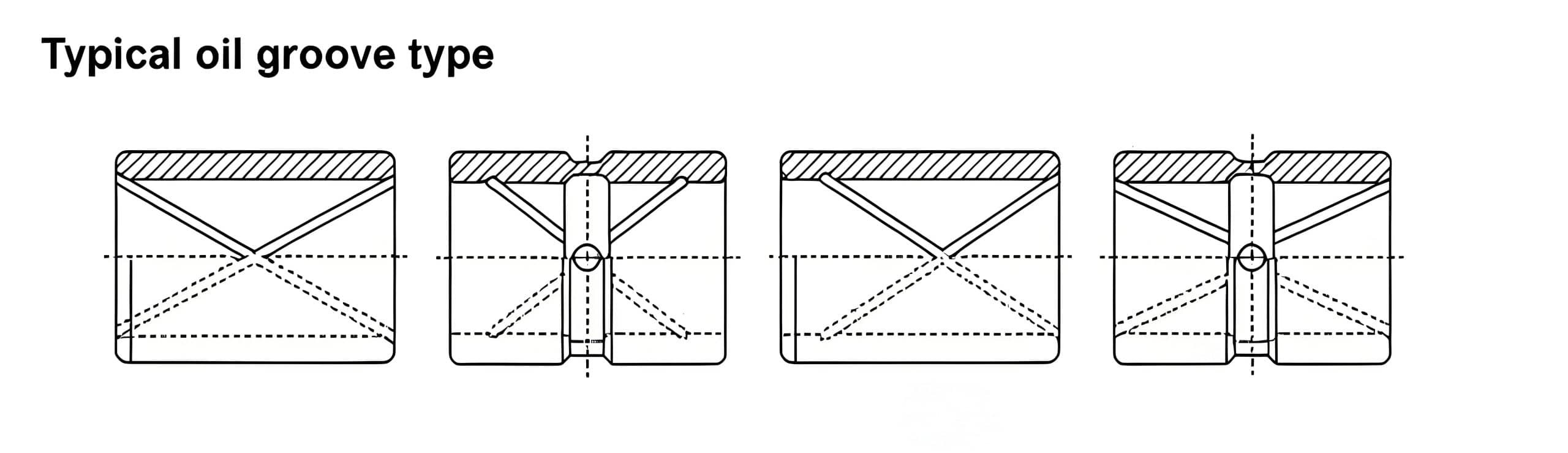
Typical Oil Groove Patterns:
The design of oil grooves varies depending on the expected direction of motion (rotation, oscillation, linear sliding), load distribution, and lubrication method. Common patterns include:
-
Straight Axial Grooves: Run parallel to the bushing’s axis. Effective for distributing lubricant along the length, particularly with oscillating or linear motion.
-
Circumferential Grooves: Run around the inner diameter of the bushing. Useful for distributing lubricant circumferentially, especially with rotational motion. Often combined with axial grooves to form a network.
-
Figure-8 or Double Loop Grooves: A classic pattern for rotational motion, designed to ensure lubricant covers the entire 360-degree surface effectively as the shaft rotates.
-
Spiral Grooves: Wind along the length of the bushing. Can sometimes provide a pumping action to draw lubricant into the bearing area.
-
Partial Grooves: Covering only specific load zones, designed to ensure lubricant is present where pressure is highest.
The Synergy: MoS2 Spray and Grooved Bushings
Now, how does MoS2 spray fit into this picture, particularly when a bushing already has oil grooves designed for liquid lubricant?
MoS2 spray typically doesn’t replace the primary liquid lubrication system in a grooved bushing application. Instead, it acts as a powerful supplement or enhancer:
-
Boundary Lubrication Insurance: While oil grooves facilitate hydrodynamic lubrication, there are always moments of boundary contact (start-up, shut-down, shock loads, very low speeds). A sprayed MoS2 film provides a robust solid lubricant layer in these critical boundary conditions, drastically reducing wear and preventing galling or seizing before the oil film fully establishes itself. The grooves themselves can sometimes help trap and retain the MoS2 particles.
-
Assembly and Run-in Aid: Applying MoS2 spray to the shaft and/or the grooved bore of the bushing during assembly ensures immediate lubrication from the first rotation or movement. This is invaluable for preventing damage during initial operation before the circulating liquid lubricant takes over. The grooves can act as micro-reservoirs for the sprayed MoS2 particles.
-
Backup in Case of Lubricant Failure: If the liquid lubrication supply is temporarily interrupted, the MoS2 film provides a degree of continued lubrication, potentially preventing catastrophic failure or buying time to address the issue.
-
Operating in Challenging Environments (with caveats): In slightly dusty or contaminated environments where wet lubricants might trap particulates, a pre-applied MoS2 spray offers a clean, dry layer that can function alongside the intended liquid lubricant without attracting as much debris. However, in heavily contaminated environments, dry lubricants can still be overwhelmed.
It’s Not Always a Direct Replacement:
It’s crucial to understand that applying MoS2 spray to a bushing designed primarily for liquid lubrication via grooves does not magically turn it into a long-term, high-load dry-running bushing like one with embedded solid plugs (as discussed in the previous example with the series). The spray film is typically thin and will eventually wear away, although the wear particles themselves can continue to provide some lubrication. The oil grooves are optimized for liquid flow, not for consistently feeding solid lubricant from a spray application over extended periods.
When to Consider MoS2 Spray on Grooved Bushings:
-
During the assembly of critical components.
-
For bearings subjected to frequent start/stop cycles.
-
Applications with potential for intermittent lubricant supply.
-
To enhance the run-in process for new machinery.
-
As an added layer of protection in high-pressure or oscillating movements where maintaining a constant oil film is difficult.
Conclusion
While bushings with oil grooves are designed for and perform best with their intended liquid lubricant, applying MoS2 spray offers a valuable supplementary layer of protection. It excels as a boundary lubricant, a run-in aid, and provides crucial anti-seize properties, especially during critical moments of operation. Understanding the function of typical oil groove patterns helps appreciate how a sprayed MoS2 film can nestle within these channels, providing localized dry lubrication exactly where it’s needed most, bridging the gap between purely dry solutions and conventionally lubricated systems. It’s a simple yet effective strategy to improve the reliability and lifespan of grooved bushings in many applications.
Unpacking Steel Graphite Bushings: Load, Speed, and Lubrication Secrets
Steel graphite bushings are workhorses in demanding industrial applications. They offer a compelling combination of strength, durability, and the crucial benefit of self-lubrication, making them ideal for environments where traditional greasing or oiling is difficult, impractical, or even undesirable. But not all steel graphite bushings are created equal. Understanding the nuances in their design and material properties is key to selecting the right one for your specific needs.Let’s delve into the technical details using the data presented in the provided specification table for Standard series bushings, illustrating how subtle differences can significantly impact performance.What is a Steel Graphite Bushing?At its core, a steel graphite bushing combines the structural integrity and load-bearing capacity of a steel shell or base material with the low friction and self-lubricating properties of graphite or other solid lubricants. This marriage allows the bushing to operate dry, reducing maintenance and preventing contamination risks associated with liquid lubricants.Going Deeper: Analyzing the steel Series DataThe table provides specifications for four different steel bushing series models: . By comparing these, we can see how variations in base material, lubricant type, and design influence performance metrics like load capacity and speed.Here’s a breakdown of the key parameters and what they tell us:
| Feature | steel with graphite bushing | ||||
| Base Material | S45C | GCr15 | S45C | GCr15 | The foundation of the bushing’s strength and rigidity. Different materials offer different properties. |
| Hardness (HRC) | ≥ 40 | ≥ 50 | ≥ 40 | ≥ 50 | Higher hardness generally means better wear resistance and potentially higher load capacity. |
| Max. Load (Mpa) | 150 | 200 | 150 | 200 | The maximum pressure the bushing can withstand in operation. Crucial for heavy-duty applications. |
| Max. Speed (m/min) | 10 | 10 | 15 | 15 | The highest surface speed the shaft can rotate or slide relative to the bushing. Affects heat generation. |
| Solid Lubricant | With film (0.01-0.03mm) | With film (0.01-0.03mm) | Solid plug embedded | Solid plug embedded | The method and form of the self-lubricating graphite. This is a critical differentiator. |
| Temp. Range (°C) | -100 ~ +300 | -100 ~ +300 | -100 ~ +300 | -100 ~ +300 | Indicates suitability for extreme temperature environments. |
| Coe. of Linear Expansion | 1.1 x 10⁻⁵ / °C | 1.1 x 10⁻⁵ / °C | 1.1 x 10⁻⁵ / °C | 1.1 x 10⁻⁵ / °C | How much the material expands or contracts with temperature changes. Important for tight tolerances. |
| Mating Tolerance | H7 Housing, e7/f7 Shaft | H7 Housing, e7/f7 Shaft | H7 Housing, e7/f7 Shaft | H7 Housing, e7/f7 Shaft | Standard fits for housing bore and shaft diameter, ensuring proper installation and function. |
Why This Matters:Understanding these differences is vital for proper bushing selection:
- For lower loads and speeds, or applications where a finite lubrication film is sufficient, the series might be suitable and potentially more cost-effective.
- For higher loads, higher speeds (within limits), or applications requiring extended maintenance-free operation and robust, continuous self-lubrication, the series with its embedded solid plugs offers superior performance. The choice between S45C (‘C’) and GCr15 (‘G’) within each series then depends directly on the required load capacity.
Beyond the Table: Contrasting with Oil GroovesIt’s important to note that the lubrication methods shown here (“With film” and “Solid plug embedded”) are forms of solid or boundary lubrication. This is distinct from traditional hydrodynamic lubrication, which relies on a pressurized film of oil or grease, often facilitated by internal oil grooves or pockets machined into the bushing surface.While some steel-backed bushings do feature oil grooves for use with external lubrication systems, the series shown in the table exemplifies self-lubricating designs that do not require external oil or grease. The embedded graphite plugs or the lubricant film are the lubrication system. This is a key advantage in many modern applications aiming for reduced maintenance, clean operation, or reliability in harsh environments.ConclusionSteel graphite bushings, particularly those featuring embedded solid lubricants, represent a powerful solution for demanding bearing applications. By carefully considering the base material (S45C vs. GCr15) for load capacity and hardness, the series for speed and lubrication method (film vs. embedded plug), engineers can select a bushing that offers the optimal balance of strength, wear resistance, and reliable, maintenance-free self-lubrication for long-term performance. Don’t just choose “steel graphite”; understand the specific type and its capabilities.
Beyond the Oil Can: Enhancing Bushing Performance with MoS2 Spray and Oil Grooves
Bushings are fundamental components in countless mechanical systems, providing surfaces for rotating or sliding motion. While many require a consistent supply of oil or grease for lubrication, achieving optimal performance, especially during start-up, under intermittent load, or in specific environmental conditions, can be a challenge. This is where solid lubricants, like Molybdenum Disulfide (MoS2), often applied as a spray, come into play, sometimes working alongside or augmenting traditional lubrication methods in bushings already equipped with oil grooves.
Let’s explore the synergy between MoS2 spray and the classic oil groove design in bushings.
What is MoS2 and Why Spray It?
Molybdenum Disulfide (MoS2) is a layered solid lubricant known for its exceptional properties, particularly under high pressure and in vacuum or high-temperature environments where oils and greases might fail. Its layered structure allows the layers to shear easily over one another, providing low friction.
Applying MoS2 as a spray offers several practical advantages:
- Ease of Application: It can be quickly and evenly applied to complex surfaces, including the inside diameter of a bushing or onto a shaft.
- Thin, Dry Film: Spray applications typically leave a thin, dry film that doesn’t attract dirt and dust like wet lubricants.
- Effective Boundary Lubricant: MoS2 excels at providing lubrication in boundary conditions – situations where a full hydrodynamic film of oil hasn’t formed (like at start-up, low speeds, or under heavy loads), preventing metal-to-metal contact.
- Run-in Aid: It helps reduce friction and wear during the critical initial run-in period of a new bearing or bushing.
Understanding Bushing Oil Grooves: More Than Just Channels
Before discussing MoS2, let’s recap the purpose of oil grooves. Bushings designed for liquid lubrication (oil or grease) often incorporate grooves on their bearing surface. These aren’t just decorative; they serve vital functions:
- Lubricant Distribution: The primary role is to distribute the lubricant (fed from a port or reservoir) evenly across the entire contact area between the bushing and the shaft.
- Reservoir Function: Grooves can act as small reservoirs, holding lubricant and ensuring it’s available, especially during start-stop cycles or periods of low lubricant supply.
- Removing Wear Debris: Lubricant flow through the grooves can help flush away small wear particles, preventing them from accumulating and causing abrasive wear.
- Cooling: The circulating lubricant helps dissipate heat generated by friction.
Typical Oil Groove Patterns:
The design of oil grooves varies depending on the expected direction of motion (rotation, oscillation, linear sliding), load distribution, and lubrication method. Common patterns include:
- Straight Axial Grooves: Run parallel to the bushing’s axis. Effective for distributing lubricant along the length, particularly with oscillating or linear motion.
- Circumferential Grooves: Run around the inner diameter of the bushing. Useful for distributing lubricant circumferentially, especially with rotational motion. Often combined with axial grooves to form a network.
- Figure-8 or Double Loop Grooves: A classic pattern for rotational motion, designed to ensure lubricant covers the entire 360-degree surface effectively as the shaft rotates.
- Spiral Grooves: Wind along the length of the bushing. Can sometimes provide a pumping action to draw lubricant into the bearing area.
- Partial Grooves: Covering only specific load zones, designed to ensure lubricant is present where pressure is highest.
The Synergy: MoS2 Spray and Grooved Bushings
Now, how does MoS2 spray fit into this picture, particularly when a bushing already has oil grooves designed for liquid lubricant?
MoS2 spray typically doesn’t replace the primary liquid lubrication system in a grooved bushing application. Instead, it acts as a powerful supplement or enhancer:
- Boundary Lubrication Insurance: While oil grooves facilitate hydrodynamic lubrication, there are always moments of boundary contact (start-up, shut-down, shock loads, very low speeds). A sprayed MoS2 film provides a robust solid lubricant layer in these critical boundary conditions, drastically reducing wear and preventing galling or seizing before the oil film fully establishes itself. The grooves themselves can sometimes help trap and retain the MoS2 particles.
- Assembly and Run-in Aid: Applying MoS2 spray to the shaft and/or the grooved bore of the bushing during assembly ensures immediate lubrication from the first rotation or movement. This is invaluable for preventing damage during initial operation before the circulating liquid lubricant takes over. The grooves can act as micro-reservoirs for the sprayed MoS2 particles.
- Backup in Case of Lubricant Failure: If the liquid lubrication supply is temporarily interrupted, the MoS2 film provides a degree of continued lubrication, potentially preventing catastrophic failure or buying time to address the issue.
- Operating in Challenging Environments (with caveats): In slightly dusty or contaminated environments where wet lubricants might trap particulates, a pre-applied MoS2 spray offers a clean, dry layer that can function alongside the intended liquid lubricant without attracting as much debris. However, in heavily contaminated environments, dry lubricants can still be overwhelmed.
It’s Not Always a Direct Replacement:
It’s crucial to understand that applying MoS2 spray to a bushing designed primarily for liquid lubrication via grooves does not magically turn it into a long-term, high-load dry-running bushing like one with embedded solid plugs (as discussed in the previous example with the series). The spray film is typically thin and will eventually wear away, although the wear particles themselves can continue to provide some lubrication. The oil grooves are optimized for liquid flow, not for consistently feeding solid lubricant from a spray application over extended periods.
When to Consider MoS2 Spray on Grooved Bushings:
- During the assembly of critical components.
- For bearings subjected to frequent start/stop cycles.
- Applications with potential for intermittent lubricant supply.
- To enhance the run-in process for new machinery.
- As an added layer of protection in high-pressure or oscillating movements where maintaining a constant oil film is difficult.
Conclusion
While bushings with oil grooves are designed for and perform best with their intended liquid lubricant, applying MoS2 spray offers a valuable supplementary layer of protection. It excels as a boundary lubricant, a run-in aid, and provides crucial anti-seize properties, especially during critical moments of operation. Understanding the function of typical oil groove patterns helps appreciate how a sprayed MoS2 film can nestle within these channels, providing localized dry lubrication exactly where it’s needed most, bridging the gap between purely dry solutions and conventionally lubricated systems. It’s a simple yet effective strategy to improve the reliability and lifespan of grooved bushings in many applications.


