
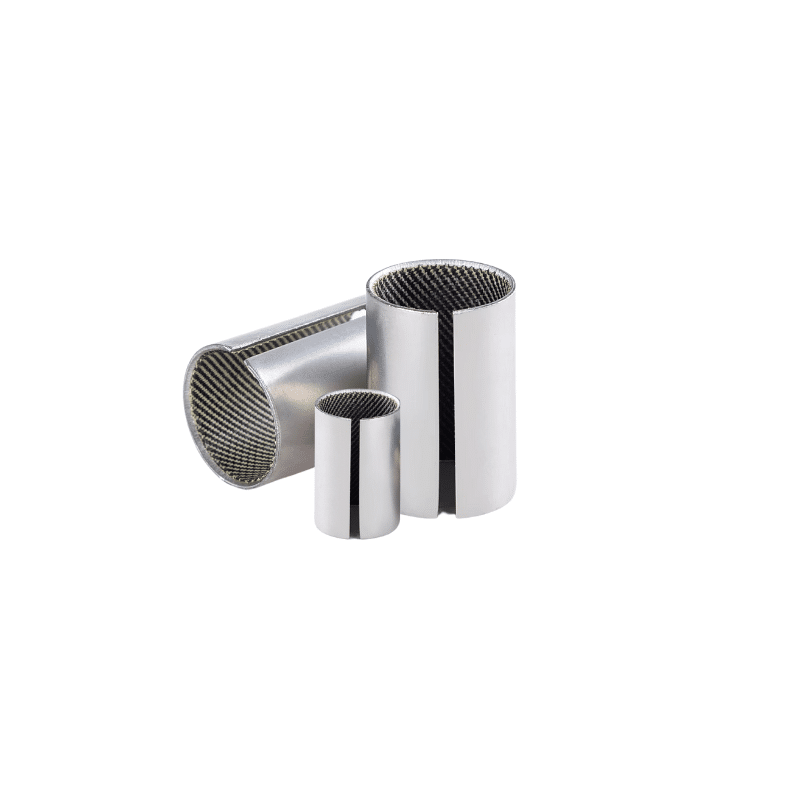

High Performance Multilayer Composite Stainless Steel PTFE Bushing Sliding Bearings
Unlock Maintenance-Free Performance: A Deep Dive into SS304/316 Stainless Steel Fiber Oil-Free Plain Bearings
In the complex machinery that drives modern industry, managing friction and wear is paramount. Traditional bearings often rely on external lubrication (oil or grease), demanding regular maintenance schedules and posing risks of contamination, especially in sensitive environments like food processing or cleanrooms. Enter the SS304/316 Stainless Steel Fiber Oil-Free Bearing, a type of self-lubricating plain bearing engineered for reliability, longevity, and zero maintenance.
This article goes beyond the surface to explore the technology, benefits, and applications of these advanced bushings, using comparisons and data to illustrate their unique advantages.
Stainless Steel Fiber Oil-Free Plain Bearings
Stainless steel fiber oil-free plain bearings are designed for high-performance, maintenance-free applications, particularly in harsh environments. These bearings typically combine the durability of stainless steel with self-lubricating materials like PTFE or similar fibers to ensure smooth operation without the need for oil lubrication.
Key Features:
Material: Made from stainless steel, offering corrosion resistance and strength.
Oil-Free Operation: The self-lubricating properties of the bearing ensure that it operates without the need for external oil or grease, reducing maintenance and extending service life.
Applications: Common in environments where lubrication is difficult or undesirable, such as food processing, clean rooms, or high-temperature operations.
Durability: Designed to withstand heavy loads, wear, and extreme conditions.
These bearings offer significant benefits for industries requiring reliability with minimal maintenance.
First, What Exactly is a Plain Bearing?
Before diving into the specifics of the fiber oil-free variant, let’s clarify what a plain bearing (or bushing) is, especially compared to its rolling-element cousins (like ball or roller bearings).
-
Mechanism: Plain bearings rely on sliding motion between two surfaces. One surface (the bearing) supports the moving part (usually a shaft). There are no rolling elements involved.
-
Contact: They typically have a larger contact area compared to rolling bearings.
-
Lubrication: While some plain bearings require external lubrication, the focus here is on self-lubricating types.
Here’s a quick comparison based on the provided points and common knowledge:
Plain Bearings vs. Rolling-Element Bearings
| Feature | Plain Bearings (Self-Lubricating Focus) | Rolling-Element Bearings (e.g., Ball Bearings) | Logic & Implication |
| Motion | Sliding Contact | Rolling Contact | Sliding generally has higher starting friction but can be smoother and quieter. |
| Lubrication | Often Self-Lubricating (Oil-Free/Maintenance-Free) | Requires Grease/Oil (Needs Relubrication) | Self-lubricating = reduced maintenance, no contamination risk from lubricant leakage. |
| Contamination | Handles contamination well; often doesn’t need seals | Sensitive to contamination; usually sealed | Better for dirty/dusty environments or where sealing is difficult/costly. |
| Temperature Range | Generally Wider (-150°C to +380°C for this type) | More Restricted | Suitable for extreme temperature applications (cryogenic or high heat). |
| Rigidity | Less Rigid (More Dampening) | More Rigid | Plain bearings can absorb shock and vibration better. |
| Noise | Generally Quieter | Can be Noisier (due to rolling elements) | Advantageous in noise-sensitive applications. |
| Shaft Material | Can run on various hardnesses (depends on liner) | Typically requires Hardened Steel Raceways | Offers more flexibility in shaft material selection and preparation. |
| Failure Mode | Gradual Wear | Often Sudden Failure (Fatigue Spalling) | Gradual wear allows for predictive maintenance. |
Anatomy of the SS304/316 Fiber Oil-Free Bearing
This specific bearing type combines advanced materials science to achieve its unique properties:
-
Stainless Steel Backing (SS304 or SS316): This forms the structural base of the bearing.
-
SS304: The most common stainless steel grade, offering excellent general corrosion resistance, good formability, and strength. Suitable for many industrial, food, and chemical environments.
-
SS316: Contains molybdenum, providing superior corrosion resistance, particularly against chlorides and pitting. Ideal for marine environments, chemical processing, pharmaceuticals, and food applications where harsh cleaning agents are used.
-
Why Stainless Steel? It provides mechanical strength, dimensional stability, excellent heat dissipation, and crucial corrosion resistance, preventing rust and degradation even in damp or chemically aggressive environments.
-
-
Self-Lubricating Fiber Layer: This is the critical functional layer. It typically consists of:
-
PTFE (Polytetrafluoroethylene): Renowned for its incredibly low coefficient of friction.
-
Reinforcing Fibers: These can be glass fibers, carbon fibers, aramid fibers, or other specialized materials woven or dispersed within the PTFE matrix. They provide mechanical strength, wear resistance, and help anchor the lubricating layer.
-
Solid Lubricants (Optional): Sometimes, other solid lubricants like MoS₂ (Molybdenum Disulfide) or graphite are incorporated to enhance performance under specific load or speed conditions.
-
How Self-Lubrication Works (Thin Film Lubrication):
This isn’t magic; it’s material science in action. During the initial run-in period, a microscopic amount of the PTFE and solid lubricant mixture transfers from the bearing liner onto the mating shaft surface. This creates an extremely thin, low-friction “transfer film.” The bearing then effectively slides on this self-generated film, achieving thin film lubrication without needing any external oil or grease. This process ensures:
-
Smooth Operation: Low friction reduces stick-slip and ensures consistent movement.
-
Reliability: The lubrication is inherent to the material; it doesn’t run out or degrade like liquid lubricants (within operational limits).
-
Noise Reduction: The sliding action on the smooth transfer film is inherently quieter than rolling elements.
Key Technical Parameters Explained
Understanding the technical specifications is crucial for selecting the right bearing. Let’s break down the provided parameters:
| Parameter | Value | Explanation & Significance |
| Product Name | Fiber Oil-Free Bearing | Descriptive name highlighting key features. |
| Keywords | Plain Bearing | Primary category for SEO and classification. |
| Max. Load (Static) | 450 N/mm² | The maximum load the bearing can withstand without permanent deformation when stationary. High value indicates robust construction. |
| Max. Load (Dynamic) | 250 N/mm² | The maximum load the bearing can handle under continuous sliding motion. |
| Max. Speed (Dry) | 1.5 m/s | The maximum sliding speed permissible without external lubrication. Exceeding this can lead to overheating and premature wear. |
| Max. Speed (Lubrication) | >2.5 m/s | If supplemental lubrication (even process fluid) is present, higher speeds are possible. Note: These are typically designed for dry running. |
| Max. PV (Dry, Short-Term) | 3.6 N/mm²·m/s | The maximum Pressure x Velocity value the bearing can tolerate for brief periods. PV is a critical indicator of the bearing’s operating limits under dry conditions. |
| Max. PV (Dry, Continuous) | 1.8 N/mm²·m/s | The maximum Pressure x Velocity value for sustained operation without overheating or excessive wear. This is a key design parameter. Higher PV = higher performance capability. |
| Temperature Range | -150°C to +380°C | Extremely wide operating temperature range, suitable for cryogenic applications up to very high-temperature processes. Far exceeds typical rolling bearings. |
| Friction Coefficient (µ) | 0.03 ~ 0.20 | Indicates the low friction nature (0.03 is very low). The range depends on load, speed, temperature, and surface conditions. |
| Thermal Conductivity | 42 W/(m·K) | Reflects the backing material’s ability to dissipate heat generated by friction. Stainless steel has decent conductivity, helping to prevent overheating. |
| Coef. of Thermal Expansion | 11 x 10⁻⁶ K⁻¹ | How much the bearing material expands/contracts with temperature changes. Important for maintaining correct operating clearances across the wide temperature range. |
| Lubricating Way | Maintenance-Free Bearing | Highlights the core benefit – no relubrication needed. |
| Lubricating Film Thickness | Thin Film Lubrication | Describes the self-generated transfer film mechanism. |
| Bearing Direction | Radial | Designed primarily to support loads perpendicular to the shaft axis. |
Understanding PV Limit: The PV value (Pressure x Velocity) is crucial. Friction generates heat. Both high pressure (P) and high sliding velocity (V) increase heat generation. The PV limit defines the maximum energy input the bearing can handle continuously without exceeding its temperature limits and causing failure. Designing within the continuous PV limit is essential for long bearing life.
Advantages That Drive Adoption
The technical features translate into tangible benefits:
-
Maintenance-Free Operation: Eliminates the cost, labor, and downtime associated with greasing schedules.
-
Contamination-Free: Perfect for food, beverage, pharmaceutical, and cleanroom applications where lubricant leakage is unacceptable.
-
Cost-Effective Lifecycle: While the initial cost might be comparable or slightly higher than some basic bearings, the elimination of maintenance, potential for longer life, and prevention of lubricant-related failures lead to a lower total cost of ownership.
-
High Load Capacity: Robust stainless steel backing and reinforced liner allow for significant static and dynamic loads.
-
Wide Temperature Range: Operates reliably in extreme conditions where traditional lubricants would freeze or break down.
-
Excellent Corrosion Resistance: SS304 and especially SS316 withstand harsh environments, washdowns, and corrosive substances.
-
Noise and Vibration Dampening: The sliding mechanism and material properties help absorb shock and run quieter than rolling bearings.
-
Tolerance to Misalignment & Edge Loading: The conformable nature of the liner can handle slight misalignments better than rigid rolling bearings.
-
Compact & Lightweight: Plain bearings generally offer a smaller radial cross-section compared to rolling bearings for the same shaft size.
Where Do These Bearings Shine? (Applications)
The combination of features makes SS304/316 Fiber Oil-Free Bearings ideal for:
-
Food & Beverage Factories: Corrosion resistance (washdowns), no grease contamination risk, wide temperature range (ovens, freezers).
-
Pharmaceutical & Medical Equipment: Cleanliness, chemical resistance, reliability.
-
Packaging Machinery: High cycles, stop/start motion, potential for dust/debris.
-
Textile Machinery (Garment Shops): Resistance to lint/dust contamination, maintenance-free.
-
Chemical Processing: Excellent corrosion resistance (especially SS316).
-
Construction Works Equipment: Robustness, contamination tolerance (dirt, dust), shock load handling.
-
Energy & Mining: Durability, wide temperature range, resistance to harsh conditions.
-
Manufacturing Plants & Machinery Repair Shops: Versatility, reliability, reduced maintenance needs across various equipment types.
-
Marine Applications: SS316’s superior resistance to saltwater corrosion.
-
Aerospace: Lightweight potential, wide temperature capability, reliability.
Beyond the Standard: High Precision, Robustness & Customization
Leading suppliers offer these bearings with features that further enhance their value:
-
High Precision: Tight tolerances ensure accurate shaft positioning and smooth operation, critical in precision machinery.
-
Robust Design: Optimized material selection and manufacturing processes maximize load capacity and resistance to shock.
-
Universal Compatibility: While specialized, their fundamental design allows integration into a vast array of machinery types across industries.
-
Easy Maintenance (Installation/Replacement): Standardized bushing forms (cylindrical, flanged) and straightforward press-fitting make installation and replacement simple, minimizing downtime.
-
Customized Services (OEM): Ability to tailor dimensions, tolerances, or even material compositions (within limits) to meet specific application requirements.
Conclusion: The Smart Choice for Demanding Applications
SS304/316 Stainless Steel Fiber Oil-Free Bearings represent a significant advancement over traditional lubricated bearings and even simpler plain bearings. By leveraging the corrosion resistance and strength of stainless steel with the low-friction, self-lubricating properties of advanced fiber/PTFE composites, they offer a truly maintenance-free, reliable, and clean solution.
Their ability to handle high loads, extreme temperatures, and contamination, coupled with quiet operation and a long service life, makes them an intelligent investment for engineers and designers seeking to improve performance and reduce the total cost of ownership in challenging industrial environments. When reliability counts and maintenance is not an option, these sophisticated plain bearings deliver.
OTHER MATERIALS
- Self-Lubricating Carbon Steel Sliding Bearings Low Friction and Long Life for Various Applications, Woven Bushing.
custom Fiber Oil-Free Bearing
Metric and Inch sizes available on request. SS304/316 Stainless Steel Fiber Oil-Free Bearings, Self-Lubricating Oilless PTFE Multilayer Composite Sliding Bearings Stainless Steel Oilless Bushing; Bushing material: self-lubricating, Bearing direction: radial,Lubration: maintenance-free, thin film
Product: self-lubricating plain bearing
Keyword: plain bearing


