
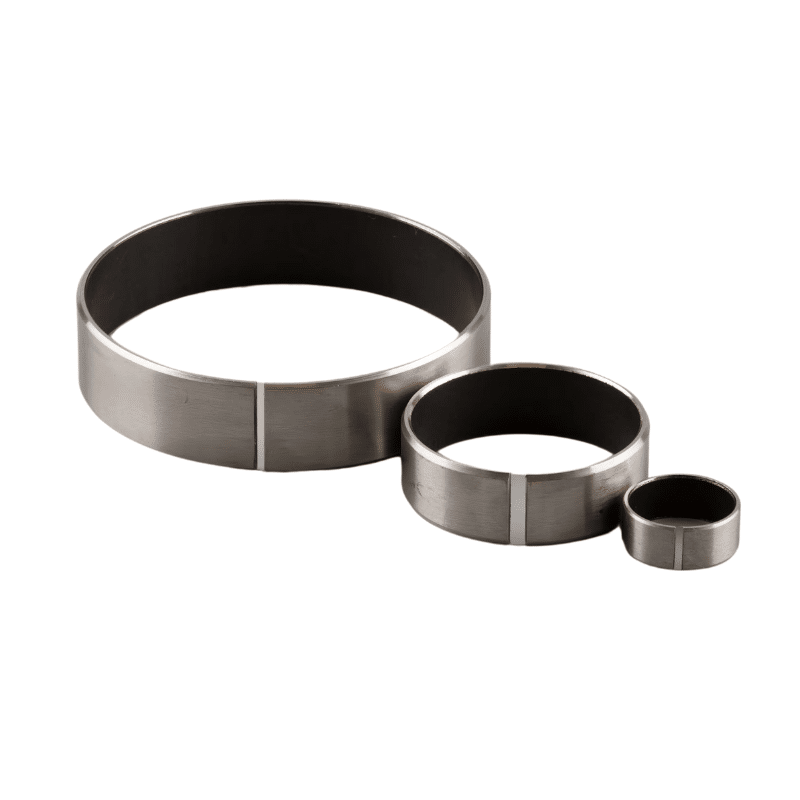

Self Lubricated Bushings Lubricating Bushings
Mastering Extreme Environments: Exploring Sprayed PTFE Stainless Steel Bushings (SS + PTFE)
Plain bushings, also known as sleeve bearings, are workhorse components designed to reduce friction and wear in linear, oscillating, or rotating applications. While many types exist, dealing with harsh operating conditions like corrosive chemicals, saltwater, or stringent hygiene requirements often presents a significant challenge for standard bearing materials.
This is where a specialized solution emerges: the Stainless Steel Based Sprayed PTFE Composite Plain Bushing. These bearings combine the inherent strength and corrosion resistance of stainless steel with the low friction and chemical inertness of Polytetrafluoroethylene (PTFE) applied via a spraying process. Often referred to by names like SF-1SS bearing, SS Sprayed bushing, SS304/SS316 stainless steel sleeve bushing, they represent a crucial option for demanding environments.
But what exactly are they made of, how do they work, and why choose them over other bearing types? Let’s delve deeper.
Unpacking the Structure: A Composite Powerhouse
Unlike monolithic (single-material) bearings, the Stainless Steel Sprayed PTFE bushing is a composite structure built for performance in specific conditions. It typically consists of two primary layers:
-
The Stainless Steel Backing (SS304 or SS316): This forms the structural foundation of the bushing.
-
Role: Provides mechanical strength, dimensional stability, and crucially, protection against corrosion.
-
Material Choice:
-
SS304: A widely used austenitic stainless steel, offering good general corrosion resistance. Suitable for many mildly corrosive environments.
-
SS316: Also austenitic, but contains molybdenum, significantly enhancing its resistance to pitting and crevice corrosion, especially in chloride-rich environments like marine applications or certain chemical processing streams.
-
-
Why it’s Important: The stainless steel back allows the bushing to handle higher loads and provides the rigidity necessary for press fitting into a housing, something pure PTFE cannot do effectively. Its corrosion resistance protects the bearing from environmental degradation, which is the Achilles’ heel of many standard steel-backed bearings.
-
-
The Sprayed PTFE Layer: This is the functional sliding surface.
-
Role: Provides the low friction, self-lubricating properties, and chemical resistance.
-
Material: Polytetrafluoroethylene (PTFE), a fluoropolymer known for its extremely low coefficient of friction, excellent chemical resistance, and wide operating temperature range.
-
Application Process: The PTFE is applied by spraying onto the prepared surface of the stainless steel back. This process creates a uniform, relatively thin coating that conforms to the back’s shape.
-
Why Spraying? While other PTFE composite bearings might use sintered porous layers filled with PTFE (like traditional SF-1 types), spraying can offer advantages in specific scenarios. It can create a more chemically resistant barrier if the stainless steel needs full protection, and allows for a direct bond to the metal surface. For this specific bearing type, the sprayed layer serves as the primary self-lubricating interface.
-
Think of it like this: The stainless steel is the strong, corrosion-proof skeleton, and the sprayed PTFE is the slick, chemically-resistant skin that interacts with the shaft.
How the Composite Works: The Synergy Effect
The magic of this bushing lies in the synergy between its layers. The stainless steel provides the structural integrity and environmental protection that pure PTFE lacks, while the PTFE provides the self-lubrication and chemical resistance that stainless steel alone cannot offer as a bearing surface.
When the shaft moves against the sprayed PTFE layer, the PTFE’s inherent low friction minimizes wear and heat generation. Small amounts of PTFE material are often transferred to the shaft surface, creating a counter-surface with even lower friction. The stainless steel back ensures the bearing maintains its shape under load and survives in conditions that would corrode carbon steel or degrade other backing materials.
Key Characteristics and Why They Matter
Based on their structure, these bushings offer a unique set of characteristics:
-
High Corrosion Resistance: Derived directly from the SS304 or SS316 backing. This is arguably the most significant advantage over standard steel-backed composite bearings. Allows use in wet, humid, marine, or chemical environments.
-
High Wear Resistance (Compared to Monolithic PTFE/Graphite): The rigid stainless steel backing prevents deformation under load, allowing the thin PTFE layer to perform more effectively and resist wear far better than a bearing made solely from soft PTFE or brittle graphite.
-
Excellent Chemical Resistance: Inherited from the PTFE sliding layer and the stainless steel backing. PTFE is inert to most chemicals, acids, and alkalis. SS provides additional protection.
-
Self-Lubricating (Oilless): The PTFE layer provides continuous lubrication, eliminating the need for external oil or grease in many applications. This simplifies design, reduces maintenance, and is essential for environments where lubrication is impractical or undesirable (like food machinery).
-
Wide Operating Temperature Range: PTFE is effective over a broad temperature spectrum (often cited as -190℃ to 280℃, though application limits depend on load/speed).
-
Suitable for Specific Conditions: While wear-resistant, the provided data (Max PV value, Max speed) suggests they are particularly well-suited for light to medium loads and medium to low speeds, especially in challenging chemical or corrosive contexts. The wear resistance is excellent within these parameters, particularly compared to materials that would fail environmentally.
Where Do They Shine? Typical Applications
Given their characteristics, Stainless Steel Sprayed PTFE bushings are ideal for applications where corrosion, chemical attack, or hygiene are primary concerns, alongside the need for self-lubrication:
-
Pumps and Valves: Handling corrosive fluids, chemicals, or water.
-
Marine Industry: Resistance to saltwater corrosion is critical for deck equipment, steering linkages, etc.
-
Food Processing and Packaging Machinery: Meets hygiene standards, resists cleaning chemicals, operates without external lubricants that could contaminate food.
-
Chemical Handling Equipment: Bearings exposed directly to acids, bases, or other reactive substances (e.g., mixers, conveyors, flowmeters).
-
Medical Equipment: Where hygiene and material inertness are paramount.
Availability & Technical Snapshot
These bushings are commonly available in standard cylindrical and flanged forms, as well as thrust washers and strips. Custom designs are also possible. Lead-free variants are often offered to meet environmental regulations.
Here’s a look at typical technical data (note: specific values can vary by manufacturer):
| Parameter | Typical Value | Significance |
| Max Load Pressure | 100 N/mm² | Maximum static or very low-speed load capacity. |
| Friction Coefficient (μ) | 0.03 – 0.18 | Indicates low friction during operation. |
| Applicable Temperature | -190℃ to 280℃ | Very wide range for extreme hot/cold uses. |
| Max Allowable PV (Dry) | 3.0 N/mm²·m/s | Performance limit under dry, dynamic load. P=Pressure, V=Velocity. Higher PV = more demanding application. |
| Max Sliding Speed | 2.5 m/s | Upper limit for dynamic motion. |
| Max Allowable PV (Oil) | 40 N/mm²·m/s | Significantly higher capacity if external lubrication is used (though they are designed for oilless use). |
(Note: PV value is a critical design parameter for plain bearings. It represents the product of bearing pressure and sliding velocity. Operating within the allowable PV limit is essential for bearing life.)
Installation Considerations
Proper installation is key for bearing performance and lifespan. Key points include:
-
Housing Tolerance (H7): Ensures a correct interference fit.
-
Shaft Tolerance (f7 to h8): Allows for proper running clearance with the bushing’s inner diameter after mounting.
-
Mounting Bevels: Crucial on both the housing and shaft to prevent damage to the delicate PTFE layer and the bushing edges during press-fitting.
-
Force Fitting: Use an appropriate mandrel to apply force evenly.
-
Lubrication Assist: Sometimes, a light application of grease on the outer surface of the bushing helps reduce installation force and prevent scoring.
Sprayed PTFE Stainless Steel vs. Other Bearings: A Comparative View
Understanding when to choose this specific type means comparing it to alternatives.
| Feature | SS + Sprayed PTFE Bushing | Standard SF-1 (Steel+Bronze+PTFE) | Monolithic PTFE Bearing | Bronze (Lubricated) Bearing |
| Base Material | Stainless Steel (SS304/SS316) | Carbon Steel | PTFE | Bronze |
| Lubrication Method | Sprayed PTFE (Self-Lub.) | Sintered Bronze + PTFE/Fillers (Self-Lub.) | PTFE (Self-Lub.) | Requires External Oil/Grease |
| Corrosion Resist | Excellent (SS back) | Poor (Steel back rusts) | Excellent (PTFE) | Moderate (Bronze can corrode) |
| Chemical Resist | Excellent (PTFE+SS) | Limited (Steel/Bronze can react) | Excellent (PTFE) | Limited |
| Load Capacity | Good (Supported by SS) | Excellent (Supported by Steel+Bronze matrix) | Low | Excellent (with sufficient film) |
| Wear Resistance | Good (Excellent in target uses) | Excellent | Fair | Good (With proper lubrication) |
| PV Capability | Moderate (esp. dry) | High | Low | High (with lubrication) |
| Ideal Application | Corrosive/Chemical/Marine/Food | General Purpose, High Load/Speed | Very Light Loads, Chemical | High Load, Requires Maint. |
| Cost | Moderate to High | Moderate | Low to Moderate | Varies (Material & Machining) |
The Contrasting Logic:
-
Choose SS + Sprayed PTFE when corrosion or chemical resistance is the primary requirement and the load/speed conditions are within its medium range. It solves the environmental vulnerability of standard SF-1 while offering significant wear/load improvement over pure PTFE.
-
Choose Standard SF-1 for high load and speed applications where corrosion is not a major factor.
-
Choose Monolithic PTFE only for very light loads in chemical environments, or as a seal/wiper, not as a structural bearing.
-
Choose Bronze when very high loads are present and external lubrication is acceptable and feasible.
Conclusion: The Right Choice for Demanding Conditions
Stainless Steel Based Sprayed PTFE Composite Plain Bushings are not a one-size-fits-all bearing, but they are an indispensable solution for specific, challenging applications. By expertly combining the structural integrity and environmental resilience of stainless steel (SS304 or SS316) with the low friction and chemical inertness of a sprayed PTFE layer, these bushings deliver reliable, self-lubricating performance in corrosive, marine, chemical processing, and food handling environments where traditional bearing materials would quickly fail.
When designing for conditions where acids, alkalis, saltwater, or strict hygiene protocols are involved, the SS Sprayed PTFE bushing stands out as a robust, low-maintenance, and highly effective choice, offering a superior combination of properties compared to monolithic PTFE, graphite, or standard steel-backed composite bearings.
This article provides general information. Always consult manufacturer specifications and application data for specific design requirements.
OTHER MATERIALS
Self-Lubricating Stainless Steel PTFE Sprayed Self-lubricating Sleeve Bushing Steel Sliding Bearings Low Friction and Long Life for Various Applications, Woven Bushing.
The Critical Role of PTFE Coating Thickness in Bearing Performance
The thickness of the PTFE coating on a composite bearing significantly influences its overall performance. This impact is primarily observed in the following key areas:
-
Friction Coefficient: PTFE is renowned for its extremely low coefficient of friction, which is the basis for the bearing’s self-lubricating property. An appropriate coating thickness is crucial for ensuring optimal performance. If the coating is too thin, it may not form a continuous or durable lubricating film, potentially leading to increased friction and premature wear. Conversely, an excessively thick coating can result in a surface that is too soft or less stable under load, affecting its low-friction behavior and potentially increasing localized wear.
-
Wear Resistance: A suitable coating thickness contributes positively to the bearing’s wear resistance. However, there’s a point of diminishing returns. If the coating is too thick, it can become more susceptible to peeling, cracking, or uneven wear patterns during operation. This can paradoxically reduce the bearing’s overall wear performance compared to a bearing with a carefully controlled, thinner layer. The ideal thickness provides sufficient material for wear life while remaining robustly adhered and structurally sound.
-
Corrosion Resistance: A thicker PTFE layer generally offers enhanced chemical corrosion resistance. This is because it provides a more substantial barrier, more effectively isolating the underlying stainless steel base from aggressive corrosive media in the surrounding environment. However, this relationship isn’t simply “thicker is always better.” An excessively thick coating can be more prone to developing pinholes, micro-cracks, or other structural defects during application or curing, which could then act as pathways for corrosive substances to reach the substrate, undermining the intended protective barrier.
-
Dimensional Accuracy: The thickness of the applied coating directly affects the final dimensions of the bearing. Maintaining strict control over coating thickness is absolutely essential for precision mechanical applications where tight tolerances are required. A coating that is too thick will cause the bearing’s outer or inner dimensions (or both, depending on the coating location) to fall outside the specified tolerance range, preventing proper assembly or affecting the bearing’s fit and function within its housing and around the shaft.
custom Stainless Steel PTFE Sprayed Self-lubricating Sleeve Bushing
PTFE-Sprayed Stainless Steel Bushing
Material: Stainless steel with sprayed PTFE. The PTFE layer must be precisely applied and its thickness matched to operating load, speed, temperature, and environmental conditions. Proper control delivers optimal self-lubrication, wear and corrosion resistance, and dimensional accuracy while preserving the stainless steel’s strength, thereby extending bearing life and reducing maintenance.


