

Self Lubricated Bushings Lubricating Bushings
Unlock Maintenance-Free Performance: A Deep Dive into SS304/316 Stainless Steel Fiber Oil-Free Plain Bearings
Beyond Grease: Self-Lubricating Stainless Steel Bearings with PTFE Woven Fabric for Heavy-Duty Valves, Pumps & Chemical Equipment
Stainless steel 316 bushings offer excellent corrosion resistance and are durable in warm chlorinated, marine, and non-magnetic environments.
Cryogenic Vessels – Gas/Material Compatibility for piping, valves, fittings, and other components using gaseous and liquid oxygen at temperatures up to 60°C and pressures up to 25 bars. Contact viiplus for more information.
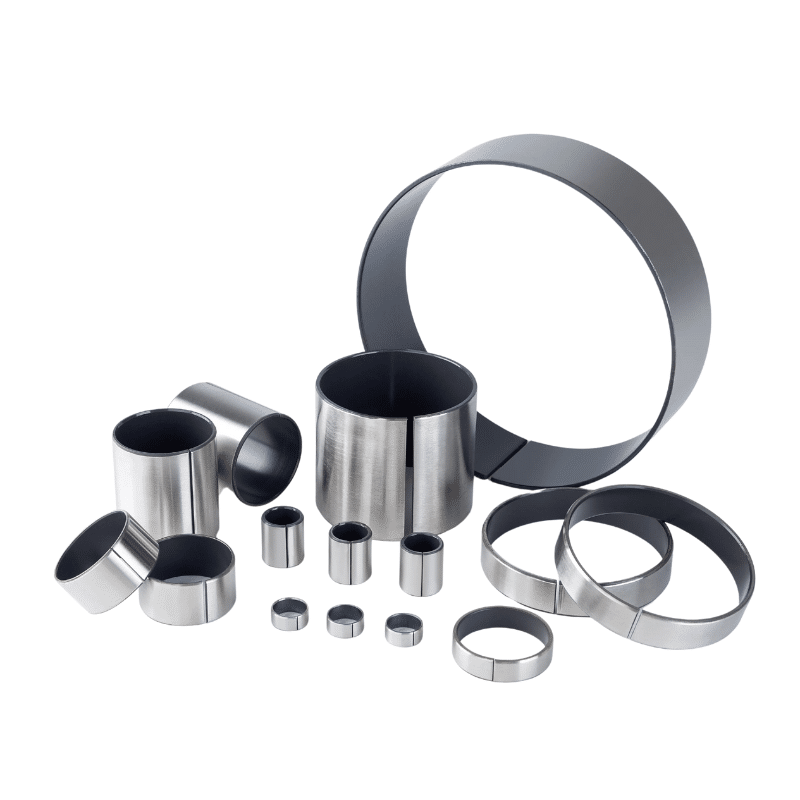
Bearing forms available in standard dimensions
• Cylindrical bushes
• Sliding plates
• Flanged bushes
• Thrust washers
• Flanged Washers
Custom bearing forms: standard dimensions, half-bearings, specialized shapes via stamping or deep drawing, bearings with locating notches, lubricant holes, machined or stamped grooves, and tailored designs.
PTFE has a low sliding coefficient that significantly reduces the torque generated by friction between parts, making additional lubrication unnecessary.
PTFE exhibits excellent stability when in contact with oxygen, chemicals, and solvents. It is weatherproof and flame-resistant. This stability arises from its steric hindrance and the strength of the C-F covalent bond (485 kJ/mol in CH3-F), which is significantly stronger than both C-H bonds and other carbon-halogen bonds.
In demanding industrial environments – think the relentless movement of a ball valve under high pressure, the constant load on a pump shaft, or components exposed to corrosive chemicals – conventional lubrication methods often fall short. Access is difficult, contaminants are present, temperatures fluctuate, and the heavy loads combined with often low or intermittent speeds make traditional bearing lubrication unreliable or impossible.
This is where advanced self-lubricating bearing technology steps in, offering a robust solution for challenging applications. Specifically, we’re focusing on a high-performance type: stainless steel bearings featuring a self-lubricating woven fabric liner, primarily made from PTFE (Polytetrafluoroethylene) fibers.
Let’s delve into what makes this material crucial for critical components in valves, pumps, and the chemical industry.
What Exactly is This Self-Lubricating Woven Fabric Material?
Unlike standard bushings or traditional composite bearings, this material utilizes a unique construction designed for extreme performance under dry or marginally lubricated conditions.
The core structure involves:
-
High-Quality Metal Backing: While the general material description allows for various metals, when combined with the stainless steel bearing as specified, the backing is typically stainless steel. This provides the necessary structural integrity, high mechanical strength, corrosion resistance (essential for chemical and water applications), and dimensional stability.
-
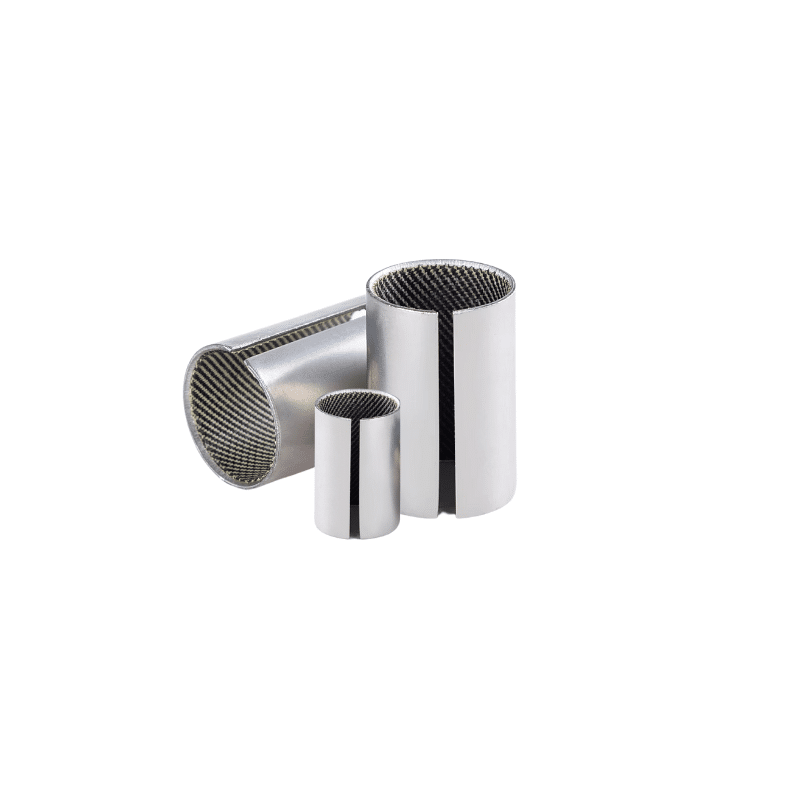
Woven Fabric Liner: This is the self-lubricating heart of the bearing. It’s a specially constructed fabric woven predominantly from PTFE (Polytetrafluoroethylene) fibers (known for their extremely low friction coefficient) combined with other high-strength, wear-resistant synthetic fibers and additives. This fabric is then securely bonded to the metal backing.
This layered structure is deliberately engineered to overcome the limitations of simpler materials. The metal backing handles the significant structural loads, while the woven PTFE fabric provides the low-friction, wear-resistant surface that allows movement without external lubrication.
A Key Distinction: The source text mentions this material structure offers “higher load capacity and longer service life compared to general three-layer composite materials.” What does this mean?
| Feature | PTFE Woven Fabric Liner Bearing (Stainless Steel Backing) | Typical Three-Layer Composite Bearing (e.g., Steel/Bronze/PTFE Mix Layer) |
| Structure | Metal Backing + Woven Fabric Liner | Metal Backing + Sintered Porous Layer (Bronze) + PTFE/Filler Overlay |
| Load Transfer | Direct transfer through dense woven structure to backing | Load transferred through porous matrix and thin overlay |
| PTFE Presence | High concentration throughout the fabric structure | PTFE dispersed as a thinner layer or within porous bronze |
| Wear Mechanism | Fabric fibers provide continuous lubrication and wear resistance as surface wears slightly | Relies on initial PTFE layer and embedded particles |
| Robustness | Highly resistant to edge loading and misalignment due to fabric nature | More sensitive to edge loading; thin PTFE layer can be scraped off |
| Key Advantage | Significantly Higher Static & Dynamic Load Capacity, Superior Wear Resistance in heavy, slow oscillating/rotating applications | Good general performance, lower cost for moderate loads |
The woven structure provides a dense, interlocked network of PTFE fibers, offering a much larger reservoir of lubricating material and mechanical strength compared to the thin, sintered layers of many conventional self-lube bushings. This is fundamental to its suitability for heavy-duty applications.
Why This Technology Excels in Heavy-Duty, Non-Greaseable Applications
The combination of a robust stainless steel backing and the advanced PTFE woven fabric liner directly addresses the challenges of heavy load, low speed, and lack of lubrication:
-
Handling Extreme Loads: The high static and dynamic load capacities (as shown in the technical data below) are directly supported by the woven fabric structure effectively transferring load to the strong metal backing. This is crucial for supporting massive valve components or heavily loaded pump shafts.
-
Optimal for Low Speeds & Oscillating Motion: At low speeds, traditional hydrodynamic lubrication (where a film of oil or grease separates surfaces) doesn’t form. Self-lubricating materials are essential. The PTFE woven fabric provides reliable boundary lubrication, minimizing friction and wear even under slow, heavy, or intermittent movement common in valve actuation or slow-turning pumps.
-
True Self-Lubrication: The PTFE fibers inherently provide a low-friction sliding surface. As the bearing operates, a thin transfer film of PTFE is deposited onto the mating surface, further reducing friction and wear without any external grease or oil. This is vital where lubrication points are inaccessible, maintenance is difficult, or contamination by lubricant is unacceptable.
-
Resistance to Harsh Environments: The stainless steel backing offers excellent corrosion resistance, while PTFE is renowned for its broad chemical inertness and wide operating temperature range. This makes the bearing ideal for use with aggressive fluids, in outdoor installations, or across significant temperature variations common in chemical processes.
Specific Applications in Valves, Pumps & Chemical Equipment
Where exactly do these specialized bearings find their home?
-
Valves (Ball Valves, Butterfly Valves, Plug Valves, etc.):
-
Specific Locations:
-
Stem Bearings/Bushings: Supporting the rotational or axial movement of the valve stem. These experience high loads, especially in larger valves or under high differential pressures.
-
Trunnion Mount Bearings (for Trunnion Ball Valves): Supporting the weight of the ball and handling thrust loads from line pressure. These are critical, heavy-load points often requiring maintenance-free operation.
-
Actuator Linkage Pivots: Points where actuator force is transferred to the valve stem, experiencing high cyclic loads.
-
-
Why Here? Enables smooth, reliable operation of the valve mechanism under high static and dynamic loads without needing periodic greasing, which can be problematic in remote locations, underwater, or where the process media must not be contaminated.
-
-
Pumps:
-
Specific Locations:
-
Shaft Bushings/Guides: Supporting and guiding the pump shaft, particularly in submerged pumps, vertical pumps, or pumps handling abrasive or corrosive media where external lubrication is difficult or impossible.
-
Wear Rings: While sometimes distinct components, the principle of using wear-resistant, low-friction materials in contact points applies.
-
-
Why Here? Provides support for the shaft while resisting wear from potential contaminants in the pumped fluid and operating reliably without conventional lubrication systems that could leak or become clogged.
-
-
Chemical Industry Equipment:
-
Specific Locations:
-
Mixer Shaft Supports: Handling significant radial and axial loads while exposed to potentially corrosive or reactive chemicals.
-
Conveyor & Handling Equipment Pivots: Used in systems transporting chemicals or operating in chemically aggressive atmospheres.
-
Process Equipment Bushings: Any point requiring support or guidance in equipment like filters, centrifuges, or reactors where lubrication access is limited or contact with process media is unavoidable.
-
-
Why Here? The chemical resistance of PTFE and stainless steel is paramount. Self-lubrication prevents lubricant degradation by chemicals and avoids process media contamination by grease or oil. The high load capacity handles the weight and forces involved in processing equipment.
-
Key Features and Benefits Summarized
Based on the material composition and structure, the advantages for these applications are clear:
-
Maintenance-Free / Reduced Maintenance: No need for external lubrication, significantly lowering operational costs and increasing uptime.
-
High Load Capacity: Excellent performance under severe static and dynamic loads (as shown in the specs).
-
Superior Wear Resistance: Long operational life even in harsh conditions.
-
Low Coefficient of Friction: Ensures smooth operation and minimizes energy loss.
-
Wide Operating Temperature Range: Reliable performance across significant temperature variations.
-
Excellent Chemical Resistance: Ideal for exposure to corrosive substances.
-
Tolerance to Contaminants: Not susceptible to failure from dust, dirt, or process media ingress like greased bearings.
-
Compact Design: No need for pumps, filters, or lubrication lines simplifies system design.
-
Corrosion Resistance (with Stainless Steel Backing): Essential for wet, humid, or corrosive environments.
Technical Specifications
Understanding the performance limits is crucial for proper selection. Here are the key technical parameters for this type of PTFE woven fabric self-lubricating material:
| Parameter | Value | Notes |
| Max Static Load | 350 N/mm² | Capacity under stationary load |
| Max Dynamic Load | 180 N/mm² | Capacity under moving load |
| Operating Temp. | -50℃ to +250℃ | Wide range suitable for many industrial processes |
| Coefficient of Friction (Dry) | 0.03 to 0.20 | Very low friction, especially important when dry |
| Max Linear Velocity (Dry) | 0.5 m/s | Suitable for low-speed applications |
| Max Linear Velocity (Fluid) | > 1 m/s | Can operate faster with lubrication (though often used dry) |
| Max PV (Dry, Short Time) | 3.6 N/mm² ⋅ m/s | A measure of pressure-velocity limit for dry operation |
| Heat Conductivity | 42 W/(m⋅K) | Helps dissipate heat generated by friction |
| Thermal Expansion Coefficient | 11 x 10⁻⁶ / K | How much the material expands/contracts with temperature |
Note: N/mm² is equivalent to MPa. 350 N/mm² = 350 MPa, 180 N/mm² = 180 MPa.
These specifications highlight the material’s ability to handle high pressures (loads) at typical low to moderate speeds found in valve actuation and pump shafts, while operating reliably across a significant temperature range. The low coefficient of friction is key to its self-lubricating capability.
Choosing the Right Bearing for Critical Applications
When designing or maintaining heavy-duty equipment operating under challenging conditions – especially where lubrication is impractical or impossible – stainless steel bearings with PTFE woven fabric liners offer a compelling solution.
| Application Scenario | Traditional Solution (Problem) | PTFE Woven Fabric Solution (Advantage) |
| Heavy Load, Low Speed (Valve Stems) | Greased Bronze/Steel (Requires frequent re-greasing, grease washout) | Self-lubricating, high load capacity, maintenance-free |
| Submerged Pump Shafts | Oil/Grease lubricated (Lube washout, contamination) | Self-lubricating, tolerant to media, corrosion resistant (stainless steel) |
| Corrosive Chemical Environment | Standard bearings (Corrosion, lube degradation) | Stainless steel base & PTFE liner resist corrosion/chemicals |
| Difficult-to-Access Bearing Points | Requires complex lube lines or difficult manual lube | Maintenance-free, eliminates need for external lube system |
| Risk of Lubricant Contamination | Leaking grease/oil pollutes process media | No external lubricant required, zero risk of contamination |
| Intermittent/Oscillating Motion | Hydrodynamic lube fails, high wear without boundary lube | Excellent boundary lubrication from PTFE woven fabric prevents wear |
For engineers and maintenance professionals facing these challenges, selecting bearings with this advanced PTFE woven fabric technology, particularly with a corrosion-resistant stainless steel backing, means investing in long-term reliability, reduced maintenance costs, and enhanced operational safety.
Conclusion
The evolution of bearing technology has provided powerful solutions for the most challenging industrial applications. Stainless steel bearings incorporating PTFE woven fabric self-lubricating liners represent a significant step forward for heavy-duty, low-speed environments where traditional lubrication is not feasible. Their exceptional load capacity, wear resistance, chemical compatibility, and maintenance-free operation make them the ideal choice for critical components in ball valves, butterfly valves, various other valves, pumps, and a wide range of chemical processing equipment.
By understanding the unique structure and performance characteristics of this material, engineers can specify bearings that ensure reliable, durable, and efficient operation, ultimately contributing to the overall performance and longevity of their systems.
OTHER MATERIALS
- Self-Lubricating Carbon Steel Sliding Bearings Low Friction and Long Life for Various Applications, Woven Bushing.
custom Fiber Oil-Free Bearing
Self-Lubricating Stainless Steel Bearings with PTFE Woven Fabric for Heavy-Duty Valves, Pumps & Chemical Equipment, Stainless steel strip
sintered bronze PTFE bushings for use in valves applied with oxygen


